

What changes

Complied ID, now in development, is built on the framework the National Child Protection Act already established. Fifty states keep fifty fitness determinations; what carries over is the verified identity, and each state and organization decides which checks it accepts.

Listen to this page 3 min
Loading the Elevenlabs Text to Speech AudioNative Player...

Part 4 of 4 · The Broken Patchwork

Prove the identity before the check
Check again every year. Carry the identity forward.

Walk me through it · about three minutes

Seven documented failures. Seven answers. Two still need Congress.

The legal framework exists. The working system does not, yet. Three questions remain.

  1. Who is this person?not which name was typed into a form
  2. Has anyone checked recently?not once, years ago, at hire
  3. Would anyone know if something changed?the same day, not at the next renewal

Technology that exists can answer them under authority Congress already granted. Two limits: the FBI’s Rap Back monitoring is open only to authorized agencies, and the 2018 national check program still needs its final rule.

Today’s model

  1. Name and date of birthidentity unverified
  2. One check, at hirerecheck interval measured in years, or never
  3. Held by one employerin one state; every move triggers a full-price rescreen
  4. Compliance by attestationsomeone signs a form

Complied ID

  1. Identity established firstbiometric and government-ID verified, with liveness and device checks; Social Security number or ITIN checked
  2. A yearly rescreen afterat launch, a new check every year and automated renewal tracking
  3. One verified identityreused across employers, states and sectors; each decides which checks it accepts
  4. Compliance by audit trailtime-stamped records a reviewer can read

Complied ID is in development: these are the capabilities FComply is building, and they will work once it launches. Federal criminal-history results reach only authorized recipients, so the record check runs through authorized channels and partner agencies, not by direct access to law-enforcement systems.

Prove the identity first

An illustrative Complied ID screen on a phone: step 1 of 4, scanning an ID, its security features read and its expiration checked

The documentScanned, checked for tampering, matched to the person.

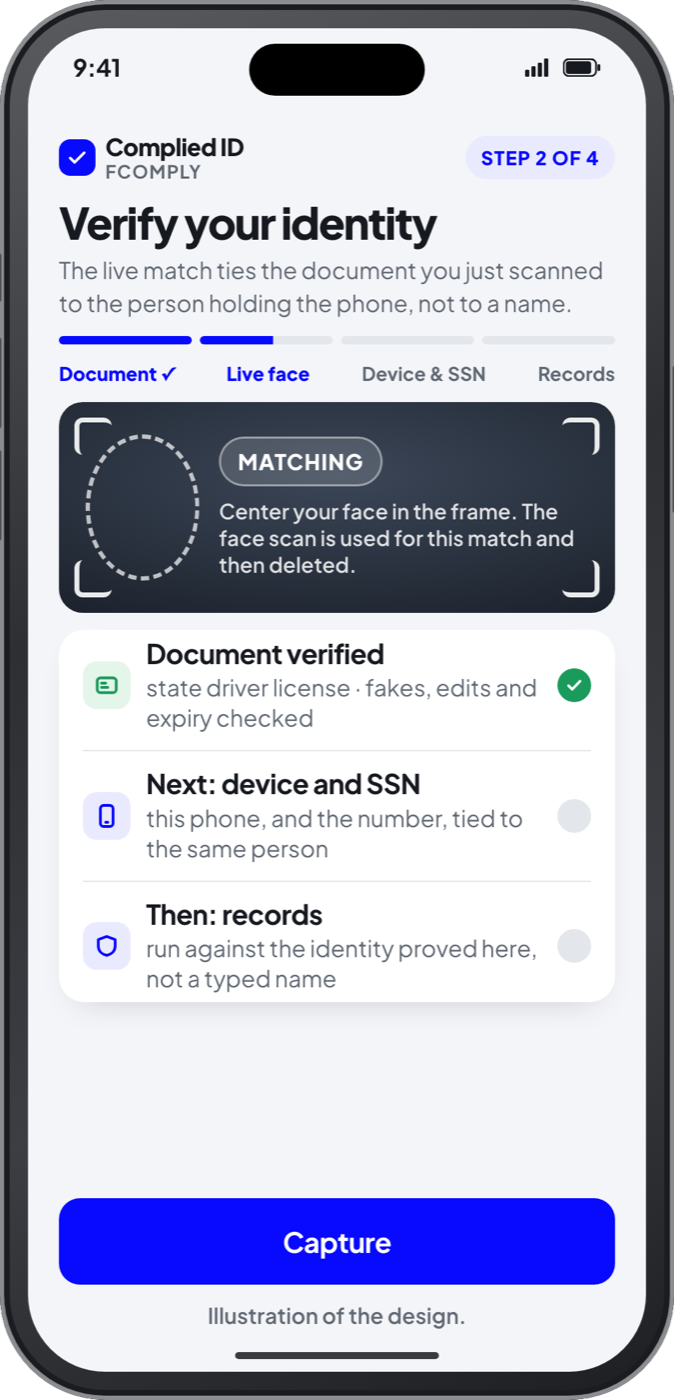
An illustrative Complied ID screen on a phone: step 2 of 4, the live face match that ties the scanned document to the person holding the phone

The live faceA liveness check designed to catch photos, masks and replayed video; the face ties the document to the phone.

An illustrative Complied ID screen on the person's own phone: ENROLLED, with the photo and name of Jordan Ellis, a fictional demonstration person; identity proven, background checks in progress

The credentialIdentity proven; at launch, records checked and a rescreen every year.

Illustrative screens of Complied ID, which is in development. At launch the person’s own phone will show ENROLLED at sign-up, SCREENING COMPLETED when the checks come back, and CERTIFIED COMPLIANT, with their photo and name, when the whole process is finished; an employer they share it with will see SCREENING COMPLETED, then CERTIFIED COMPLIANT.

Seven failures, seven answers

Each documented failure, answered.

  1. 01Screening authorized, not required
    Complied ID, as designedScreening built on a reusable verified identity, designed to be cheap and auditable enough that the permissive route becomes the default route.needs Congress or a federal recommendation to close fully
  2. 02No uniform disqualifying standard
    Complied ID, as designedThe identity and the record beneath the determination would be standardized; the determination stays with the state.needs Congress or a federal recommendation to close fully
  3. 03State-by-state fragmentation
    Complied ID, as designedAt launch, coordinated federal and state screening across jurisdictions, through authorized channels and partner agencies.
  4. 04Same access, screened three ways
    Complied ID, as designedAt launch, one screening standard available to any qualified entity, whatever the employer’s licensing category.
  5. 05Non-compliance, missing audit trails
    Complied ID, as designedTime-stamped records, automated renewal tracking, a digital audit trail.
  6. 06One-time screening
    Complied ID, as designedAt launch, a rescreen every year, with automated renewal tracking.
  7. 07Identity fraud and silos
    Complied ID, as designedIdentity-first biometric and government-ID verification, plus one verified identity other agencies can confirm; each decides which checks it accepts.

Numbered as on Seven failure modes. Complied ID is in development; these are the capabilities FComply is building, and they will work once it launches.

The seven failures and capabilities as first written
Documented failure Complied ID, as designed
01 Law authorizes screening but does not require it, and shields those who do not Builds screening on a reusable verified identity, designed to be cheap and auditable enough that the permissive route becomes the default route. Closing this completely still needs a mandate or a federal recommendation.
02 No uniform disqualifying standard Would standardize the identity and the record beneath the determination; the determination stays with the state.
03 State-by-state fragmentation At launch, coordinated federal and state screening across jurisdictions through authorized channels and partner agencies.
04 Sector gaps; the same access screened three ways At launch, one screening standard available to any qualified entity, whatever the employer’s licensing category.
05 Non-compliance and missing audit trails Time-stamped records, automated renewal tracking, a digital audit trail.
06 One-time screening; risk windows of a year, or five At launch, a rescreen every year, with automated renewal tracking.
07 Identity fraud and information silos Identity-first biometric and government-ID verification, plus one verified identity other agencies can confirm; each decides which checks it accepts.

The Attorney General shall, to the maximum extent possible, encourage the use of the best technology available in conducting background checks.

34 U.S.C. §40102(c)(2) · National Child Protection Act of 1993, as amendedFormerly 42 U.S.C. §5119a. A duty, not merely an authority: Congress placed an affirmative obligation here in 1993 and it remains in force.
No new law needed
Finish the 2018 program

The three populations in the statute match the three on this page exactly. The duty was written in 1993 and names no particular technology. The statutory standard is deliberately dynamic. The practice has not moved with it.

1

Finish the 2018 program

The President directs the Attorney General to issue the final rule for the national check program Congress ordered in 2018. It was proposed in August 2023 and is still not final. FComply intends to compete to be one of the designated entities that run its checks.
2

Recognition

Of identity-verified screening, repeated on a schedule, as the best technology available.
3

A limited pilot

With qualified entities across at least two of the three protected populations.
4

A path to continuous monitoring

For vetted qualified entities, to the service the FBI already runs.
5

One table

At which ACF, CMS and BJS, each of which owns a piece of this, can meet.

None of it requires a new federal mandate on employers, preemption of state fitness determinations, or endorsement of any single vendor.

The actions in one paragraph

What follows from that requires no new legislation: first, finishing the 2018 national check program, which only needs its final rule; then recognition of identity-verified screening, repeated on a schedule, as the best technology available; a limited pilot with qualified entities across at least two of the three protected populations; a path for vetted qualified entities to the continuous-monitoring service the FBI already runs; and one table at which ACF, CMS and BJS, each of which owns a piece of this, can meet. It does not require a new federal mandate on employers, preemption of state fitness determinations, or endorsement of any single vendor.

  • 34 U.S.C. §§40101–40104, National Child Protection Act of 1993 as amended (formerly 42 U.S.C. §5119 et seq.); P.L. 105-251, Volunteers for Children Act of 1998.
  • GAO, National Child Protection Act implementation review, GGD-97-32 (1997).
  • U.S. Census Bureau, Vintage 2024 National Population Estimates; CDC, “CDC Data Shows Over 70 Million U.S. Adults Reported Having a Disability,” July 16, 2024.
  • U.S. Bureau of Labor Statistics; Pew Research Center (Sept. 2024); PHI, Key Facts 2025; U.S. Census Bureau and AmeriCorps, Volunteering and Civic Life in America (Nov. 2024).
  • Office of Juvenile Justice and Delinquency Prevention, 1998 screening guidelines (NCJ 167248), reporting a 1995 American Bar Association study of youth-serving organizations’ screening practices.

The CAPTA finding is a newsroom survey and is described as one. Corrections to info@fcomply.com.