
Two audits, one population: 74,353 missing-from-care episodes of two calendar days or longer, from data provided by 46 state agencies for July 1, 2018 to December 31, 2020; each audit read its own stratified random sample of 100 and extrapolated. One tested the report to NCMEC; the other tested the report to law enforcement for entry into NCIC.
What the OIG actually found
Two federal audits measured whether states reported children missing from foster care as the law requires. The numbers are widely quoted and often quoted wrongly. Here they are, decomposed correctly, with links to both reports.
Listen to this page 3 min
Loading the Elevenlabs Text to Speech AudioNative Player...
100 episodes read one by one
Estimates for all 74,353
Walk me through it · about three minutes
Two tables, two samples of one hundred, and the numbers people get wrong.

An estimated 47% of episodes never reported to NCMEC and 22% late; 19% not properly reported to law enforcement for NCIC entry.
The first audit (A-07-21-06102, March 2023) tested the report to the National Center for Missing & Exploited Children. The second (A-07-21-06104, May 2023) tested the report to law enforcement for entry into the FBI’s National Crime Information Center. Both legs are required by 42 U.S.C. §671(a)(35)(B).
74,353
missing-from-care episodes of two days or longer in 46 states, July 2018 to December 2020
34,869
estimated never reported to NCMEC (47%)
16,246
estimated reported to NCMEC late (22%)
13,983
estimated not properly reported for NCIC entry (19%)
51,115
estimated not in accordance on the NCMEC leg, late or never (69%)
Estimates from two separate stratified random samples of 100, one per audit, drawn from the same 74,353 episodes in 46 states. HHS-OIG A-07-21-06102 (March 2023) and A-07-21-06104 (May 2023).
One hundred sampled episodes per audit, one dot each.
- Report to NCMEC, 100 sampled episodes: 33 within 24 hours, 22 late, 45 never.
- Report to law enforcement, a separate sample of 100 episodes: 86 within 24 hours, 8 late, 6 never.
The two audits, in ninety seconds
Two audits, two reports. Say which one you mean.
The OIG’s explanation was structural, not moral: “State agencies generally lacked adequate systems to readily identify whether or not they had reported missing children episodes to NCMEC accurately and in a timely manner.” Agencies did not know what they had and had not reported.
NCIC entry needs the report first
An estimated 13,983 not properly reported
An estimated 47% never · 22% late
July 2018 to December 2020
Agencies could not readily tell whether a report had been made: a records problem before it is a reporting problem.
The audits put the failure in one place: agencies could not readily tell whether a report had been made. That is a records problem before it is a reporting problem. If a child’s absence is recorded as a case note rather than an event, and the report to NCMEC is a phone call rather than a logged action, then a year later nobody can say what was done. The states that will pass the next audit are the ones whose systems record, at the moment it happens, that a child could not be located, that law enforcement was told, and that NCMEC was told — with times attached.
That is the problem FComply’s Foster Care Compliance System, an active concept FComply is building with developers and investors, is designed around: presence verified at every check-in, exceptions raised the same day, and a record made at the time. How that serves a state agency facing the next audit is set out separately.
Recommendations accepted
“Lacked adequate systems”
What closes the gap

The daily check-inThe agency learns the same day that a child was not produced.
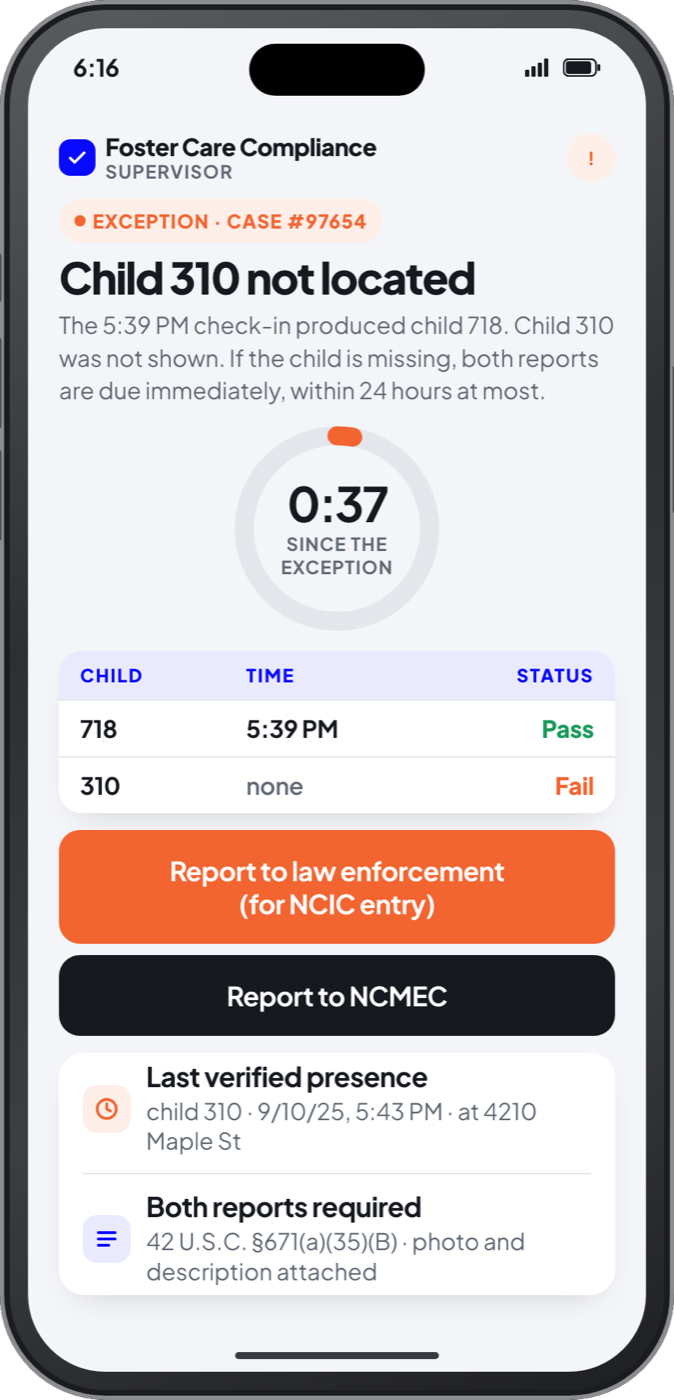
The exceptionIf the child is missing, the 24-hour reporting clock is visible to everyone who can act on it.
Illustrative screens of the Foster Care Compliance System as designed.
Sources for this section
Sources: HHS-OIG, A-07-21-06102, State Agencies Did Not Always Ensure That Children Missing From Foster Care Were Reported to the National Center for Missing and Exploited Children in Accordance With Federal Requirements, March 2023 (oig.hhs.gov · full report, PDF); HHS-OIG, A-07-21-06104, State Agencies Can Improve Their Reporting of Children Missing From Foster Care to Law Enforcement for Entry Into the National Crime Information Center Database as Required by Federal Statute, May 2023 (oversight.gov, PDF); The Imprint, Audit Finds Missing Foster Kids Underreported (imprintnews.org); HHS-OIG, OEI-07-23-00480, Alaska Missed Opportunities to Protect American Indian and Alaska Native Children Missing from Foster Care, February 2026 (oig.hhs.gov, PDF). Every figure on this page is traced to the document it comes from, with the supporting sentence quoted, in Supporting material (rows F5, S4 and S5). Last reviewed September 2026; corrections to info@fcomply.com.
Frequently asked questions
Is it true that 69% of missing foster children were not reported?
Not quite. The correct statement is that an estimated 69% of missing-from-care episodes were not reported to NCMEC in accordance with the requirements: 47% were never reported and 22% were reported late. Saying that 69% “missed the deadline” folds two different failures into one, and the audit counted episodes, not children.
Did the audits look at every state?
No. They used data from 46 state agencies; four states did not provide enough information. Each audit drew its own stratified random sample of 100 from the 74,353 episodes of two days or longer, July 2018 to December 2020, and extrapolated. The estimates describe those 46 states together, not any single state’s reporting rate.
Why is the NCIC leg so much better than the NCMEC leg?
The audits do not give a systemwide reason. OIG could not determine why the unreported episodes were missed; one state agency said it saw reporting to NCMEC as law enforcement’s job. NCMEC reminds agencies that a report to law enforcement does not automatically generate a report to NCMEC. The result: an estimated 69% not in accordance on one leg of the same rule, 19% on the other.
How should I quote these numbers?
Count episodes rather than children: one child can go missing several times, and the audits measured 74,353 episodes. Keep “never” and “late” apart, because they are different failures. Name the leg and the period — 69% is the report to the National Center, 19% is the report to law enforcement, and both describe July 2018 to December 2020 — and cite the report numbers, A-07-21-06102 and A-07-21-06104.
What happened after the audits?
Each report made a single recommendation: that the Administration for Children and Families work with state agencies to ensure compliance with the federal reporting requirements. ACF concurred with both, had issued updated guidance to states in December 2022 and held informational webinars; the NCIC recommendation was recorded as implemented on August 23, 2024. We found no national follow-up. A February 2026 OIG review of American Indian and Alaska Native children missing from foster care in Alaska found case files lacked documentation that NCMEC was notified in 57 percent of 44 applicable 2023 incidents.
Protect the vulnerable and build trust at scale.
© 2026 Federal Compliance Systems, Inc. All rights reserved.