
1993 to 2026The laws, then the measurements
The problem
Federal law already sets out the core protections for children in foster care. What is missing is a system that can prove who the caregivers are and where the children are.
Listen to this page 4 min
Loading the Elevenlabs Text to Speech AudioNative Player...
The film · 10 minutes
Proven Once
The whole problem in ten minutes, with the source for every claim.
Watch the filmEvery law assumes someone is checking
Nothing in the system verifies it
Walk me through it · about three and a half minutes
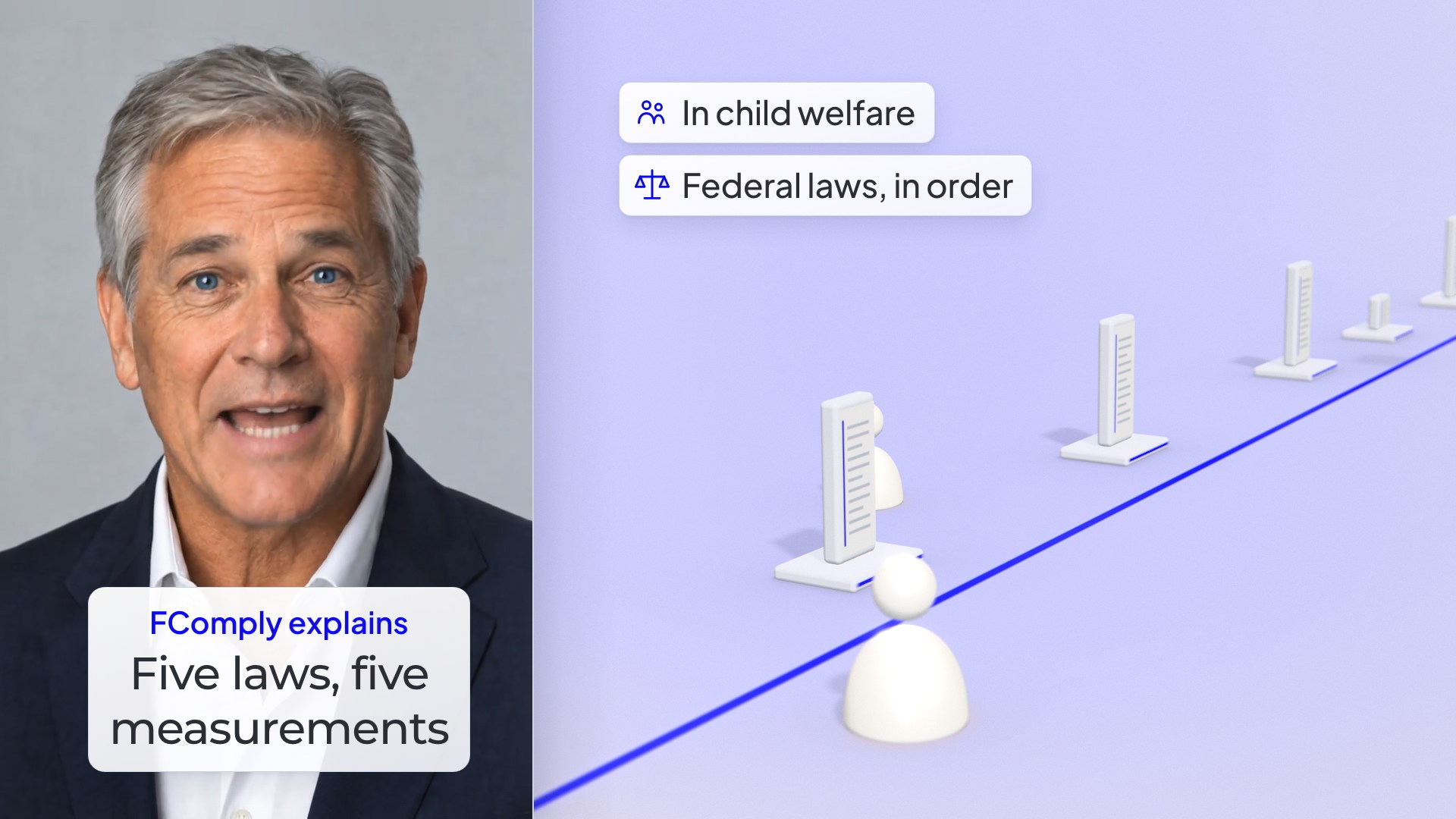
Five laws, five measurements, and one question none of them answered.
The evidence, in two pages
Part 1The Broken PatchworkTwenty-eight laws. Most require no check.Twenty-eight federal laws since 1965 in FComply’s catalog. Most require no background check; where one does, it is a condition on federal funds to states. A check by name alone can miss a record when someone gives a false identity.28federal laws since 1965, in our catalogRead part 1 →Part 2The Foster Care Compliance GapEleven requirements. One missing capability.Eleven requirements for every child in care. States dispute none of them, and none can prove, at the time and independently, that each one happened.11federal requirements, 1980 to 2023Read part 2 →
From 1993 to 2026 the same question goes unanswered: how does the agency know?
Thirty-three years of laws that assume someone is checking
Blue is what Congress wrote into law. Orange is what happened when someone measured.
The laws
1993
National Child Protection Act
As passed, Public Law 103-209 let states set up procedures for national, fingerprint-based criminal-history checks of child care providers. The Act itself required no one to be checked.
2006
Adam Walsh Child Protection and Safety Act
Fingerprint-based checks of state and federal records before any prospective foster or adoptive parent is finally approved.
2010
National Background Check Program
Affordable Care Act §6201: a voluntary, grant-funded program to check long-term-care workers. Twenty-nine jurisdictions (27 states, DC and Puerto Rico) took part between 2010 and 2024; the Inspector General credits it with helping 27 of them develop programs. The last two ended participation on May 31, 2024.
2014
The 24-hour duty
Public Law 113-183, the Preventing Sex Trafficking and Strengthening Families Act: report every child missing from care to law enforcement for NCIC entry and to NCMEC, immediately, and in no case later than 24 hours.
2016
The duty in force in every state plan
The law gave states two years. By September 29, 2016, the 24-hour rule bound every state’s Title IV-E agency, with no delay allowed.
2023
Two additions to the duty
Public Law 117-348 §137 added regular communication with law enforcement and NCMEC, a duty of its own, and required each report to include, where reasonably possible, a photograph, a physical description and endangerment information.
What the measurements found · 2022 to 2026
2022110,446
missing-from-care episodes in 30 months
The national snapshot
States reported these episodes, involving 43,679 children, to HHS-OIG for July 2018 to December 2020. In the 46 states with data, 6,619 children were still missing at the period’s end. (A-07-20-06095)
202347%
of the 74,353 episodes of two days or longer in the 46 states with data, July 2018 to December 2020, never reported to NCMEC, by OIG’s estimate
The audits
OIG estimated another 22% of episodes were reported late. For the report to law enforcement, OIG estimated 19% were not reported as required for NCIC entry. (A-07-21-06102 and A-07-21-06104)
20231,790
children reported missing from Georgia’s care in five years
A Senate investigation
NCMEC identified 410 of them as likely child sex trafficking victims, in testimony to the U.S. Senate Judiciary Subcommittee on Human Rights and the Law.
202523,348
reports of children missing from care that NCMEC received in 2025
NCMEC’s year
By NCMEC’s own classification, 17 percent of those children were identified as likely victims of child sex trafficking.
2026
Required visits missed before most incidents
HHS-OIG’s Alaska evaluation, February 2026: in nearly 60 percent of incidents reviewed, Alaska had not made all required caseworker visits before the child went missing (American Indian and Alaska Native children, 2023).
The pattern
Every law assumes the agency knows who the adults are and where the child is. Nothing in the system verifies either, so nothing can prove it.
Laws: P.L. 103-209 (1993); Adam Walsh Child Protection and Safety Act (2006); Affordable Care Act §6201 (2010); P.L. 113-183 (2014); P.L. 117-348 §137 (2023). Measurements: HHS-OIG A-07-20-06095 (May 2022), A-07-21-06102 (Mar 2023), A-07-21-06104 (May 2023), OEI-07-23-00480 (Feb 2026); U.S. Senate Judiciary Subcommittee on Human Rights and the Law (2023); NCMEC (2025).
6,619 children still missing at the period's end
From state data, in HHS-OIG's 2022 report
Thousands of hands hold one duty, and billions a year cannot be tied to a verified outcome.
Nobody is failing on purpose. The duty was spread across 56 state and territorial jurisdictions, 575 tribal nations and thousands of organizations, and the systems they were given record what people type rather than what was verified. The auditors found that state agencies “generally lacked adequate systems to readily identify whether or not they had reported missing children episodes to NCMEC accurately and in a timely manner.” That is a design problem, and design problems have fixes.
Walk me through it · about three and a half minutes
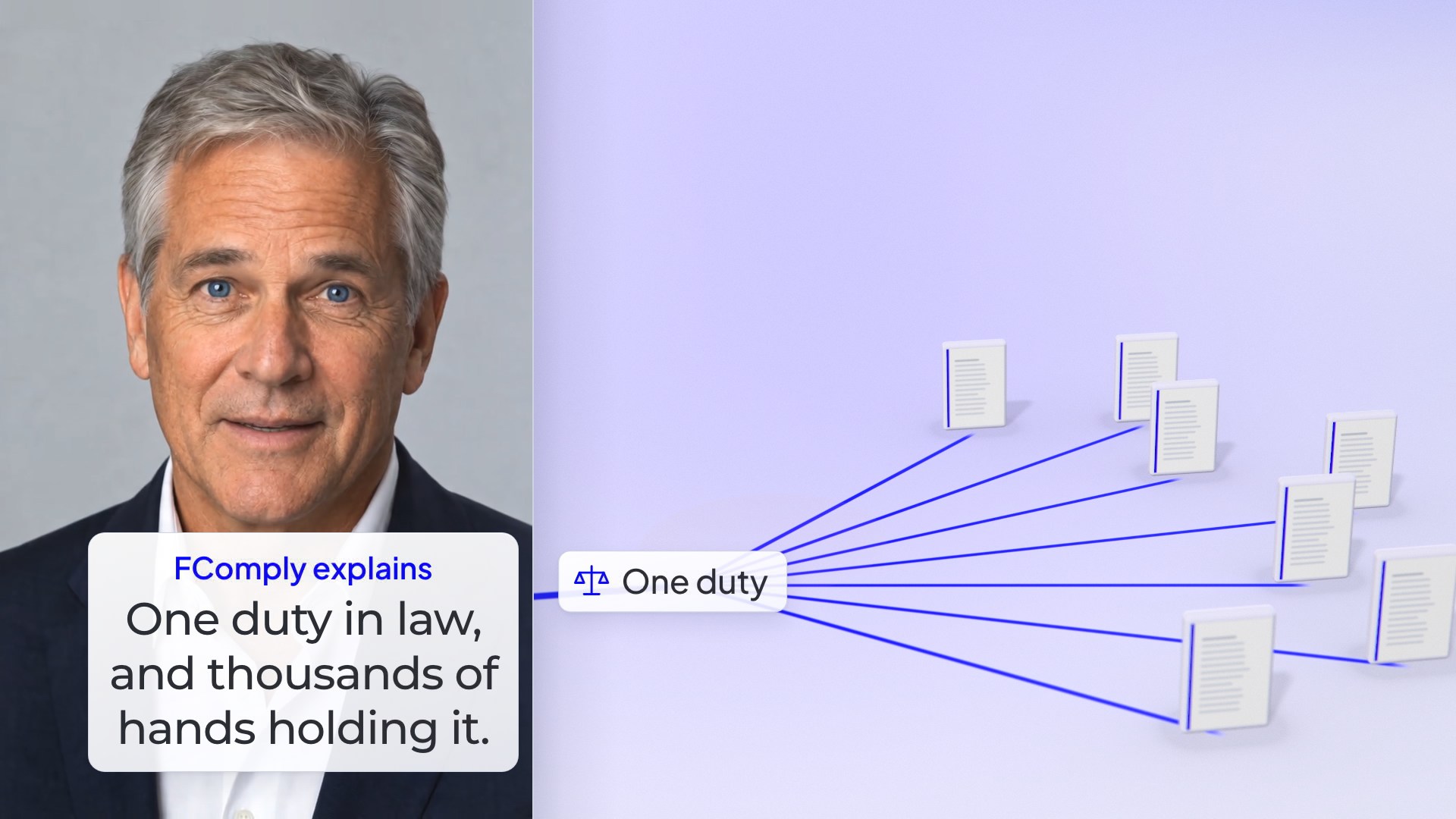
One duty, thousands of hands, and nobody holds the whole record.
This film walks part two, from the thousands of hands that hold one duty and the money that follows the laws rather than the outcome, to the three reasons it cannot work as built and why the fix is a verification layer, not a new database.
56
jurisdictions
50 states, DC and 5 territories, each with its own statute and system
575
tribal nations
federally recognized, with custody jurisdiction under ICWA
9
county-administered states
where the duty splits again across every county (2018 federal count)
One duty in law:know who the caregivers are and where the children are.
1,954
screening companies
each running its own checks (a 2019 industry estimate)
190,000
licensed providers
licensed child-care centers and homes in the states that report counts, before foster homes and care agencies
Thousands
private agencies
child-placing agencies, care providers and youth organizations
Counts: Children’s Bureau and Congressional Research Service (56 state and territorial jurisdictions); Bureau of Indian Affairs, 91 FR 4102, January 30, 2026 (575 federally recognized tribes), and the Indian Child Welfare Act, sec. 101 (tribal custody jurisdiction); Child Welfare Information Gateway, March 2018 (nine county-administered states); Consumer Financial Protection Bureau, Market Snapshot: Background Screening Reports, October 2019, citing IBISWorld (1,954 companies, a 2019 estimate); Child Care Aware of America, 2024 data (at least 190,844: 92,550 licensed centers in 40 reporting states and 98,294 licensed family child-care homes in 39).
Where the money goes · scaled to the largest line
Federal child-welfare fundingfiscal year 2026 · mostly Title IV-E foster care and adoption assistance
$11.7B
State and local child-welfare agency spendingstate fiscal year 2022 · all sources, federal funds included
$34.3B
State child-welfare information systemspast decade · fewer than a third of projects operational
~$2B
Figures as quoted in the sources below: Congressional Research Service IF10590 (federal, FY2026); Child Trends, Child Welfare Financing SFY 2022 (agency spending from all sources); HHS/ASPE on CCWIS, June 2026 (reported claims). Almost half of agency spending goes to out-of-home placements, and none of it can be tied to a verified outcome, because the outcome was never measured at the moment it happened.
Three reasons it cannot work as built
Fragmented
One duty, thousands of holders, no shared record.
Turn overEach jurisdiction, agency and screening company keeps its own piece. A child who moves, or a caregiver who works for two organizations, is a new record each time, and the OIG found agencies generally lacked systems to readily identify whether they had reported.
Turn backOne-time
A check describes one day. The risk is in the years after.
Turn overThe standard check is run at hire or approval and rarely repeated; federal child care rules require a new one at least once every five years. It says nothing about the years in between, and a check by name alone can miss a record when someone gives a false identity (Attorney General’s report, 2006).
Turn backUnverified
Systems record what people type, not what happened.
Turn overA visit is a form; a placement is a field; a report is a note. After ten years and about two billion dollars, fewer than a third of state child-welfare system projects are operational, and the federal rule for these systems never mentions a photograph or law enforcement.
Turn backA verification layer beside the case-management systems states already run, under authority Congress granted in 1993.
Two things would become verified events instead of entries. A caregiver would be shown to be who they claim and checked this year, and a child would be shown to be present, with a photograph, a place and a time. Everything the law asks for, the 24-hour report, the monthly visit, the screening before approval, would then have a record made at the moment it happened. Complied ID is being built and, at launch, will prove who the caregiver is. The Foster Care Compliance System, an active concept FComply is building with developers and major investors, is designed to prove where the child is, beside the case-management systems states already run. FComply’s proposed rollout is set out on How it would roll out, and to see which steps each app would show under your state’s rules, see how it works in your state.
The Attorney General shall, to the maximum extent possible, encourage the use of the best technology available in conducting background checks.
Every figure on this page is traced to its source, among them the HHS Office of Inspector General, NCMEC, the U.S. Senate subcommittee investigation into Georgia, the Congressional Research Service, HHS/ASPE, the Children’s Bureau, the Bureau of Indian Affairs, the Consumer Financial Protection Bureau, Child Trends and Child Care Aware of America. Each is traced to its document, with the supporting sentence quoted, in Supporting material; how to quote the audit figures without distorting them is in our guide to the OIG audits. The two-page PDF handout is drawn from this page. The whole site, one page: the site map.
- HHS-OIG, A-07-20-06095, National Snapshot of State Agency Approaches to Reporting and Locating Children Missing From Foster Care, May 2022: oig.hhs.gov
- HHS-OIG, A-07-21-06102 (March 2023) and A-07-21-06104 (May 2023); see our guide.
- HHS-OIG, OEI-07-23-00480, Alaska evaluation, February 2026: oig.hhs.gov (PDF)
- NCMEC, Our Impact (2025 data): missingkids.org
- U.S. Senate Judiciary Subcommittee on Human Rights and the Law, Georgia foster care investigation, 2023 to 2024: the release of November 6, 2023
- HHS/ASPE, CCWIS Implementation Shows Minimal Progress, June 2026: aspe.hhs.gov
- 45 CFR 1355.50 to 1355.59, the federal rule for Comprehensive Child Welfare Information Systems (CCWIS), as of September 2026 (it mentions neither a photograph nor law enforcement): ecfr.gov
- Congressional Research Service, IF10590, Child Welfare: Purposes, Federal Programs, and Funding: congress.gov
- Bureau of Indian Affairs, list of 575 federally recognized tribes, 91 FR 4102, January 30, 2026: federalregister.gov
- Child Welfare Information Gateway (Children’s Bureau), Major Federal Legislation Concerned With Child Protection, Child Welfare, and Adoption: childwelfare.gov
- Consumer Financial Protection Bureau, Market Snapshot: Background Screening Reports, October 2019 (1,954 companies, citing IBISWorld): consumerfinance.gov (PDF); Child Welfare Information Gateway, State vs. County Administration of Child Welfare Services, March 2018: childwelfare.gov (PDF); Child Care Aware of America, Price Landscape 2024: childcareaware.org; Child Trends, Child Welfare Financing SFY 2022: childtrends.org (PDF)
Prepared September 2026. Figures are quoted as published; corrections to info@fcomply.com.
Protect the vulnerable and build trust at scale.
© 2026 Federal Compliance Systems, Inc. All rights reserved.