
“Chain of custody” is borrowed from evidence handling: an unbroken record of who had an item, when, and what was done with it. Applied to a child in care, it is a continuous, tamper-evident record of identity, presence and movement, built from events verified at the time they happened.
Digital chain of custody
Case-management systems record what a worker types. A chain of custody records what was verified, when, and where. The missing-from-care audits found agencies generally lacked adequate systems to show whether they had reported missing children accurately and on time.
Listen to this page 2 min
Loading the Elevenlabs Text to Speech AudioNative Player...
Which child, where, when, by whom
Appended, never edited
Walk me through it · about three minutes
Seven properties a record needs before anyone can rely on it.
Federal visit rules ask for no timestamp, location or biometric proof of a visit; the OIG auditors found agencies generally lacked systems to show whether missing children were reported.
Every child in foster care is already the subject of a great deal of documentation. Placement records, court orders, case notes, visit logs. Yet the federal monthly-visit rules ask for no timestamp, location or biometric proof that a visit happened. A visit log says a caseworker recorded a visit, not that the caseworker saw the child, and a placement record says where a child should be, not that the child is there. When the HHS Office of Inspector General audited missing-from-care reporting, it found that agencies “generally lacked adequate systems to readily identify” whether they had reported missing children to NCMEC accurately and on time (HHS-OIG, A-07-21-06102, March 2023). That is a failure of records.
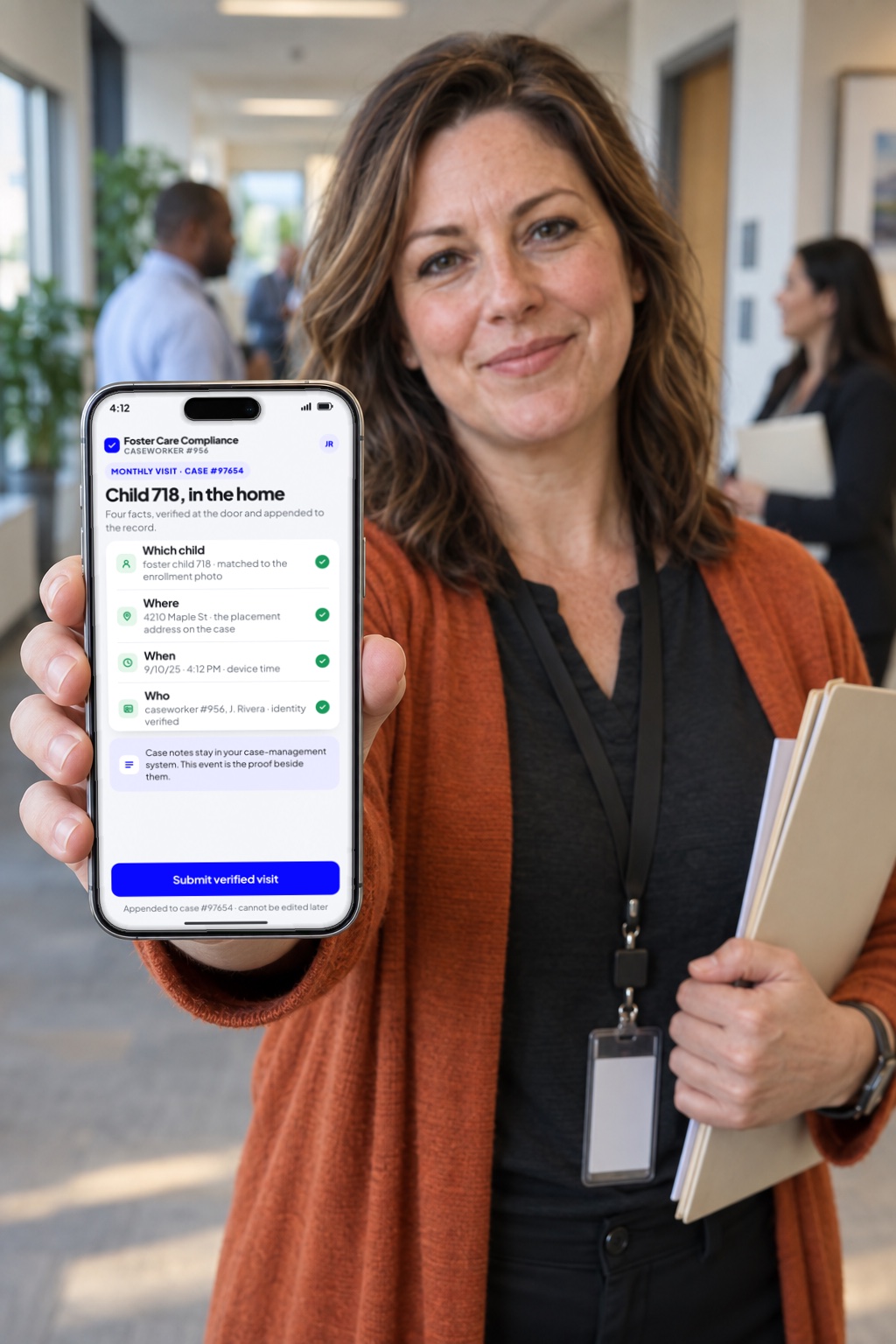
Made at the door, not at the desk
Appended to the child’s record
5
elements of a chain of custody, from enrollment to the longitudinal record
0
edits: entries are appended, never rewritten
1
record per child, from the day of enrollment to the day of exit
One child’s record · appended, never edited
- Enrollmenta real-time photo bound to the case identity
- Monthly visit · verifiedcaseworker, in the home, matched, timed
- Check-in · verifiedcaregiver, at the placement
- Today’s eventcreated by the device present, at the moment it happened
What one verified event contains
- Which childlive photo matched to the enrollment photo — biometric, not a name in a field
- WhereGPS position from the device, compared with the placement address on file
- Whendevice time, recorded as the event is created, not typed in afterward
- Who created itthe caregiver or caseworker, their role, and what the agency then decided
If there is no match, or the child is not there
- An exceptionraised at that moment, not at the next scheduled contact
- Seen the same dayby the supervisor, under the agency’s missing-child procedures
- Between events, nothing is trackedthe record proves what the adults did and when, and shows an auditor the whole chain
Four events captured at the moment they happen, and the record they add up to, from enrollment to the day the child leaves care.
Five elements
The chain starts with knowing which child. Enrollment captures a real-time photograph and binds it to the child’s case identity, so that every later check compares a live capture against that reference rather than against a name in a field. Enrollment prevents substitution — one child presented for another — and misidentification across placements.
A presence check is a single verified event: a biometric photo capture, matched against the enrollment photo, combined with a precise GPS position, at a recorded time. It answers three questions at once — which child, where, when — and it answers them with evidence created in the moment, not recalled afterward.
Presence checks initiated by the caregiver at the placement, on a cadence the agency sets. They are the routine heartbeat of the record. A child who is present produces a check-in; a child who cannot be produced generates an exception. Between check-ins nothing is tracked.
Federal law requires states to set standards for monthly caseworker visits with children in foster care. Verifying the visit means the caseworker’s check-in is itself a presence event — timestamped, geo-verified, matched to the child — so that visit-compliance rates are calculated from verified visits rather than completed forms.
Each event is appended to a record that follows the child across placements, caseworkers and years. Read forward, it shows where the child was and who confirmed it. Read backward from an incident, it shows what the agency knew and when. It is the document an audit, a court or a legislative inquiry asks for, produced as a by-product of ordinary practice.

Which child, where, when
Made in the moment
The five elements, on the phone

EnrollmentThe child’s identity, tied to a real-time photo.

Proof of presenceBiometric photo capture and GPS at the home.

Geo-verified check-inThe caregiver’s daily confirmation.
Illustrative screens of the Foster Care Compliance System as designed.
A same-day exception instead of a discovery at the next visit, a visit rate that is verified, and an answer for the auditor with a time on it.
The 24-hour reporting rule depends on the agency learning quickly that a child is missing. A chain of custody makes that a same-day exception rather than a discovery at the next scheduled contact. Monthly-visit figures can rest on recorded visits rather than self-report alone, and placement payments can be checked against evidence of presence. Forty state agencies told the OIG their procedures were to keep paying providers after a child went missing, some beyond the 14 days federal guidance allows. And when the next audit asks whether a child’s absence was reported, the answer is in the record with a time on it.
This is the category FComply’s Foster Care Compliance System, an active concept FComply is building with developers and investors, is designed for: verifying both identity and location while keeping a longitudinal record of each child’s safety, presence and movement. What it means for a state agency or a child-placing agency is set out on those pages.
Made at the event, kept for the audit
Appended, never edited
What the auditor sees

A verified monthly visitFour facts, timestamped at the door.

A closed exceptionReported inside the 24 hours, with the record of when.
Illustrative screens of the Foster Care Compliance System as designed.
Source: HHS-OIG, A-07-21-06102 (March 2023), p. 5, for the quoted finding; HHS-OIG, A-07-20-06095 (May 2022), pp. 6 and 22, for maintenance payments; 42 U.S.C. §§622(b)(17) and 624(f), for the monthly-visit standards. Every figure on this page is traced to the document it comes from, with the supporting sentence quoted, in Supporting material (rows F5 and S2). Last reviewed September 2026; corrections to info@fcomply.com.
Frequently asked questions
Is this surveillance of children?
No. As FComply designs the system, the child is not tracked. A check-in is a discrete event, initiated by a caregiver or caseworker, that confirms the child is present at that moment and place. Between events nothing is recorded. The record exists to prove that the adults responsible did what they were supposed to do.
Who owns the record?
The agency responsible for the child. As designed, FComply’s role is to create verified events and hold as little personal data as possible; results would be delivered to the agency’s systems and made visible to the people it authorizes.
What happens when a check-in fails?
As designed, it becomes an exception, visible to the supervisor the same day. The agency decides what it means — a missed appointment, a child at school, a child who cannot be located — and the decision and its time are part of the record.
Does a photo at every check-in raise privacy concerns for the child?
It should be governed by the agency’s policy and the child’s rights. As designed, the biometric comparison is made against the enrollment photo; the purpose is to confirm the child is the child, not to build a gallery.
Protect the vulnerable and build trust at scale.
© 2026 Federal Compliance Systems, Inc. All rights reserved.