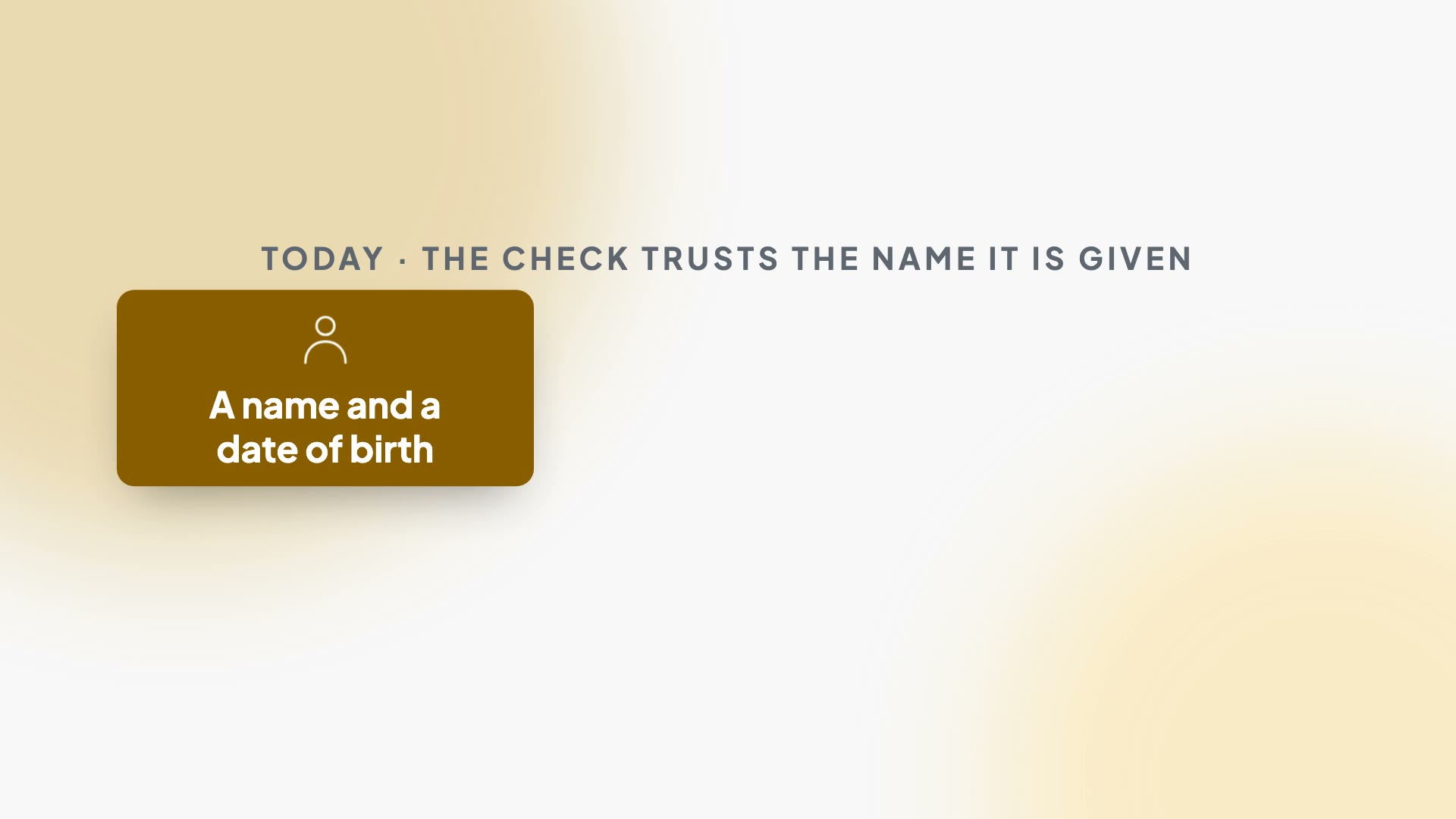
Today’s check trusts the name it is given: one records search, on one day, and nothing again for years. A borrowed or synthetic identity comes back clean.
Why one-time checks fail
The National Child Protection Act is more than thirty years old. The check it made standard answers one question about one name on one day. That is not the risk vulnerable people face.
Listen to this page 3 min
Loading the Elevenlabs Text to Speech AudioNative Player...
A check is only as good as the identity
One day, one name, then nothing
Walk me through it · about three minutes
Six things a screening system should do. The check is only one of them.
It let organizations run national criminal-history checks — and fixed in place the idea that protection is a check, done once, at the start.
The National Child Protection Act of 1993 let organizations run national criminal-history checks on the people they hire. Public Law 103-209, signed December 20, 1993, was extended in 1994 to care of the elderly and people with disabilities and amended again in 1998 by the Volunteers for Children Act. It covers the volunteers organizations accept as well as the staff they employ. It was a genuine advance: it required states to report or index child abuse crime records in the national system and gave care organizations a state-run route to a national fingerprint check.
It also fixed an idea in place that has outlived its usefulness — that protection is a check, an event that happens once, at the start.
Today · the check trusts the name it is given
- A name and a date of birthborrowed, invented, or real — nobody checks
- Records searchonce, at hire or approval
- “Clear”true for the name; meaningless for the person
A synthetic identity has no history to find, so the check comes back clean. Then nothing is checked again for years.
With Complied ID, as designed · prove the person, then check, then check again every year
- Documentgovernment ID validated; fakes and edits detected
- Live facematched to the document; a liveness check designed to catch photos, masks and replayed video
- Device and SSNdevice, location and Social Security number or ITIN checked
- Records searchfederal and state, through authorized channels, against the proven identity
- Every yearrescreened at launch, with an alert the same day a rescreen finds a disqualifying record
One verified identity is re-authenticated in a click by the next organization, so the person is not re-collected; each organization still decides which checks it accepts. Complied ID is in development and will work once it launches.
In three directions: forward in time, backward to the identity, and sideways across state lines.
Three blind spots
A background check describes the day it is run. A caregiver approved in 2019 may have been charged, convicted or placed on a registry in any year since, and the organization that approved them will not know unless it looks again. Most do not (in a 2021 survey of organizations worldwide, only 19% reported checking again after hire). The federal caseworker-visit standard, the foster-parent approval process and most state licensing rules are built around an initial check, with re-screening left to the organization’s discretion and budget.
A check is only as good as the identity it is run against. Present a genuine-looking document with someone else’s clean history, or a synthetic identity — real fragments assembled into a person who does not exist — and the check returns nothing, because there is nothing to find. A 2019 Federal Reserve paper cites a McKinsey estimate that synthetic identity fraud is the fastest-growing type of financial crime in the United States, and the same techniques work on any process that begins by trusting a name and a date of birth. Name-based checks are the most exposed; fingerprint-based checks are better but still inherit whatever identity was enrolled.
Requirements differ by state, by program and by role. A person turned away by one agency can be accepted by another that checks less, or checked again from scratch by a third at full cost and delay. There is no shared, portable proof that a person has been verified and screened.
The check is only as good as the identity
19,888 counterfeit licenses, one mail facility, six months
Today · the one-time check
- Hireone check
- Yr 1
- Yr 2
- Yr 3
- Yr 4
- Yr 5
- Yr 6
- Yr 7
- Yr 8
- Yr 9
- Yr 10
One check, on a name and a date of birth, on one day. Nothing is known about the years that follow — and nothing at all if the identity presented was not real. A borrowed or synthetic identity returns a clean record, because there is no history to find.
With Complied ID, as designed · identity first, then every year
- HireID proved
- Yr 1
- Yr 2
- Yr 3
- Yr 4
- Yr 5
- Yr 6rescreen finds a record
- Yr 7
- Yr 8
- Yr 9
- Yr 10
The person is proved first (document, liveness, device) and their Social Security number or ITIN checked; then the records are checked, and checked again every year. A disqualifying record found by a rescreen raises an alert the same day. One verified identity is re-authenticated in a click by the next organization instead of being re-collected. Complied ID is in development; this is how it will work once it launches.
A check describes the day it was run
Nothing looks again for years
The clearest data come from foster care; the six things to do instead are in the film from 0:28.
The clearest data come from foster care, where the federal government measures outcomes. Across the country 331,747 children were in care on September 30, 2025 and 501,745 passed through it during the year (ACF AFCARS, preliminary). When the HHS Office of Inspector General audited what happened when children went missing from foster care between 2018 and 2020, it found that in 45 of 100 sampled episodes the missing child was never reported to the National Center for Missing & Exploited Children. The same records problem sits under caregiver screening: an organization that cannot say when a person was last checked, or against what identity, is trusting a document in a file.
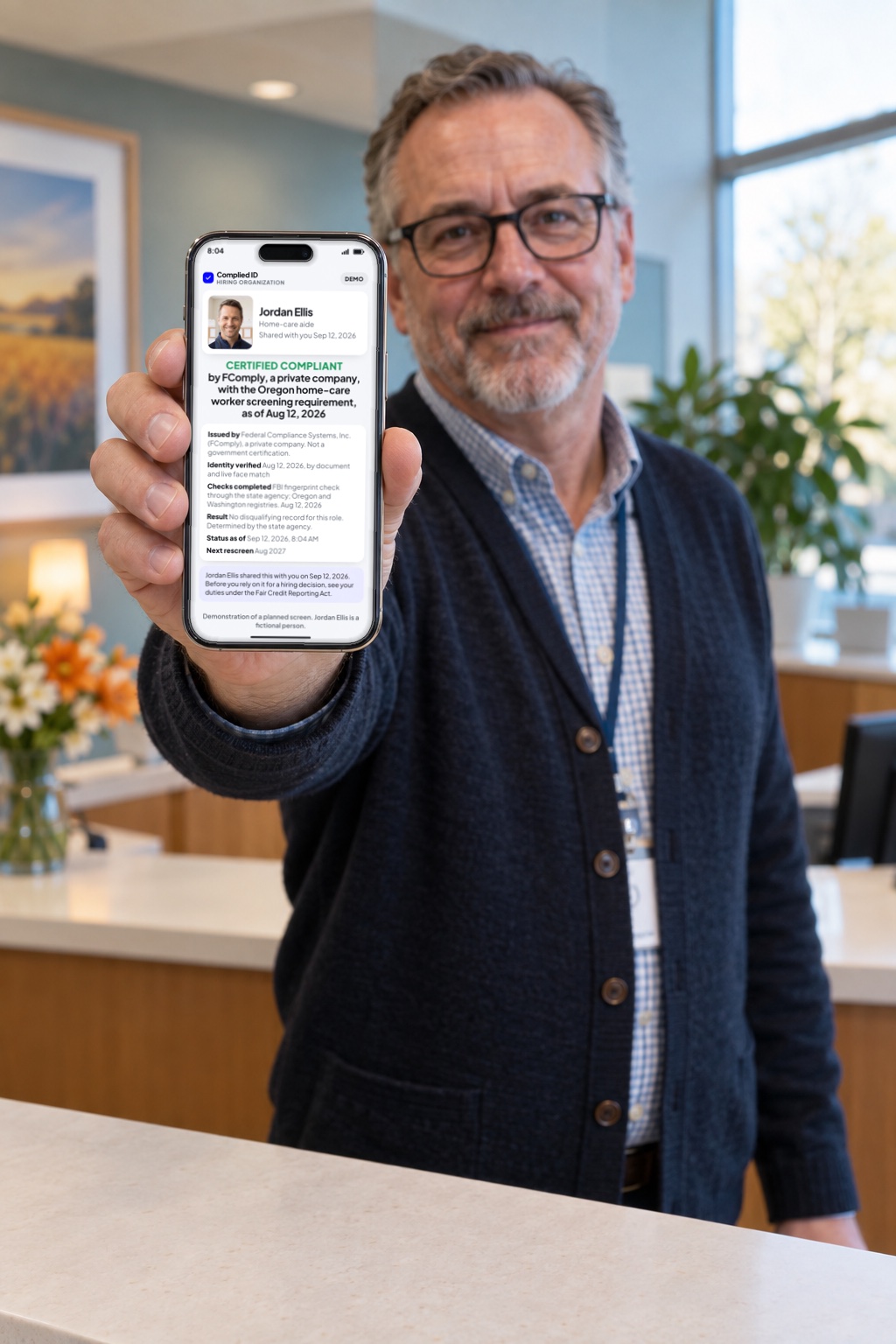
Proven identity, then the check
Rescreened every year, at launch
The six requirements a screening system should meet — prove the person first, then check, then keep checking, alerting, sharing and storing as little as possible — are in the film from 0:28 to 1:37. That is the design of Complied ID, which FComply is building now and which will work once it launches. How it applies to senior and disability care and to foster care agencies is set out on those pages.

What “instead” looks like

Prove the documentFake-ID detection and a match to the live face.
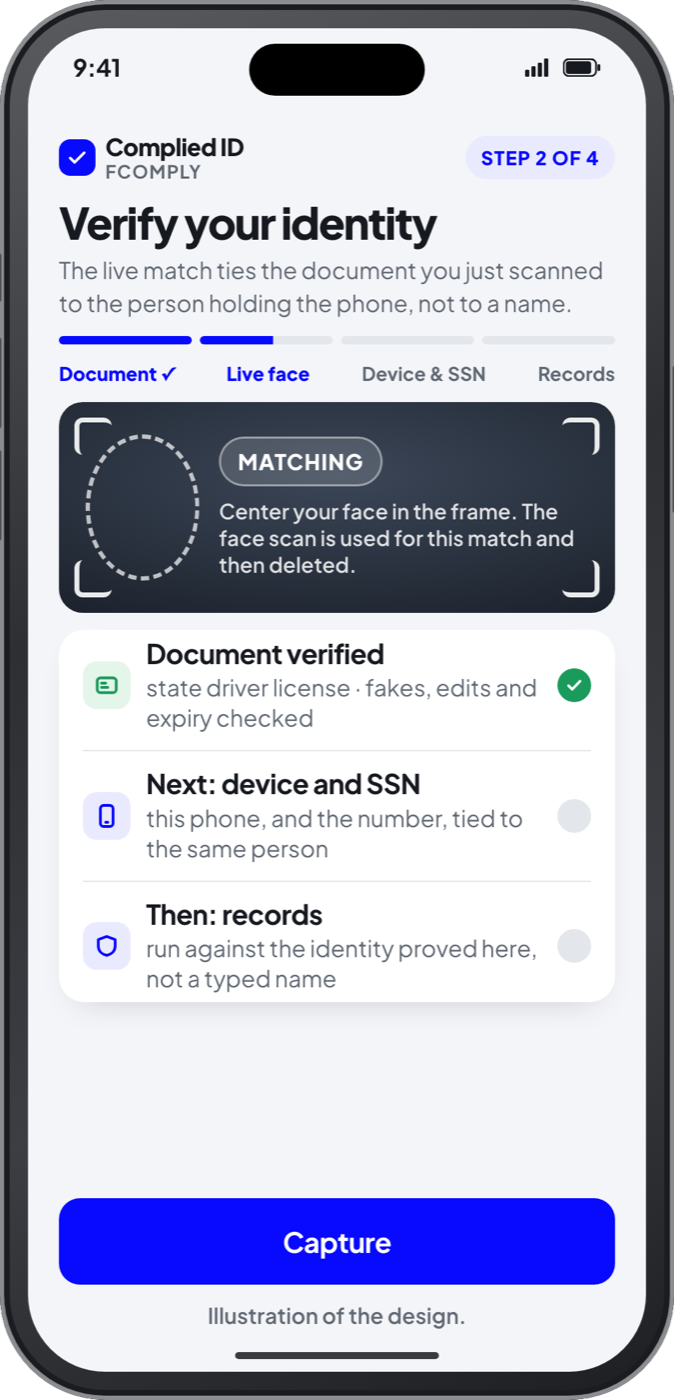
Prove the personLiveness, device and location. The SSN or ITIN is checked as well.

Then check the recordsFederal and state checks on a proven identity, repeated every year.
Illustrative screens. Complied ID is in development: FComply is building it now, and it will work once it launches.
Sources for this section
Sources: National Child Protection Act of 1993, Public Law 103-209, as amended by Public Law 103-322 (1994); Volunteers for Children Act, Public Law 105-251 (1998); Board of Governors of the Federal Reserve System, Synthetic Identity Fraud in the U.S. Payment System (2019) and subsequent Payments Improvement work on synthetic identity; HR.com and PBSA, background screening survey (Aug. 2021); U.S. Customs and Border Protection, Chicago International Mail Facility (July 27, 2020); AFCARS Dashboard No. 33, Preliminary FFY 2025 Estimates as of February 27, 2026, Children’s Bureau, ACF; HHS-OIG, A-07-21-06102 and A-07-21-06104 (2023). Every figure on this page is traced to the document it comes from, with the supporting sentence quoted, in Supporting material. Last reviewed September 2026; corrections to info@fcomply.com.
Frequently asked questions
Are fingerprint-based checks enough?
They defeat a simple alias, which is real progress over name-based checks. They still describe one day, and they still assume the enrollment identity — the name, date of birth and documents on file — was genuine. Fingerprints attached to a synthetic identity return a clean record.
What is rap back and why does it matter?
Rap back is a subscription some states and the FBI offer: the authorized agency or employer that enrolled a person is notified, directly or through a state agency, when a new arrest or other record event is reported for that person (an arrest is not a conviction). It is the right idea, but availability is uneven and it covers only the criminal-history part of the problem. An annual rescreen is not the same thing: it finds a new record at the next yearly check, not the day it is reported, but it can run wherever a check can, and it starts from a verified identity. That is how Complied ID, now in development, is designed to work once it launches.
How much does recurring screening cost compared with a one-time check?
The check itself is the smaller cost; the larger costs are collecting the same documents again, chasing people for them, and the administrative time. A system that keeps a verified identity and re-authenticates in one click removes most of that, which is why FComply prices by the year rather than per check. Its Complied ID offer, for people and organizations that pay their own way, is $49 to enroll, government fees included, then $10 a year to renew.
Does any of this apply outside child welfare?
It applies wherever adults work unsupervised with people who cannot protect themselves: senior care, home health, disability services, youth organizations, volunteers. The statute that authorizes these national checks covers, as amended, the people those services reach: children, the elderly and individuals with disabilities.
Protect the vulnerable and build trust at scale.
© 2026 Federal Compliance Systems, Inc. All rights reserved.