
Sources for this section
Sources: the public laws cited; SSA §§422(b)(17), 424(f); 45 CFR §1356.71.
Nine public laws, one statutory standard in the Social Security Act and one federal regulation. Note the direction of travel: in 2014 Congress required a report on every missing child; in 2023 it added a duty to keep in regular contact until recovery.
Part 1 of 5 · The Foster Care Compliance Gap
Walk me through it
Nine statutes, one Social Security Act standard and one regulation, and why every one of them is a timestamp problem.
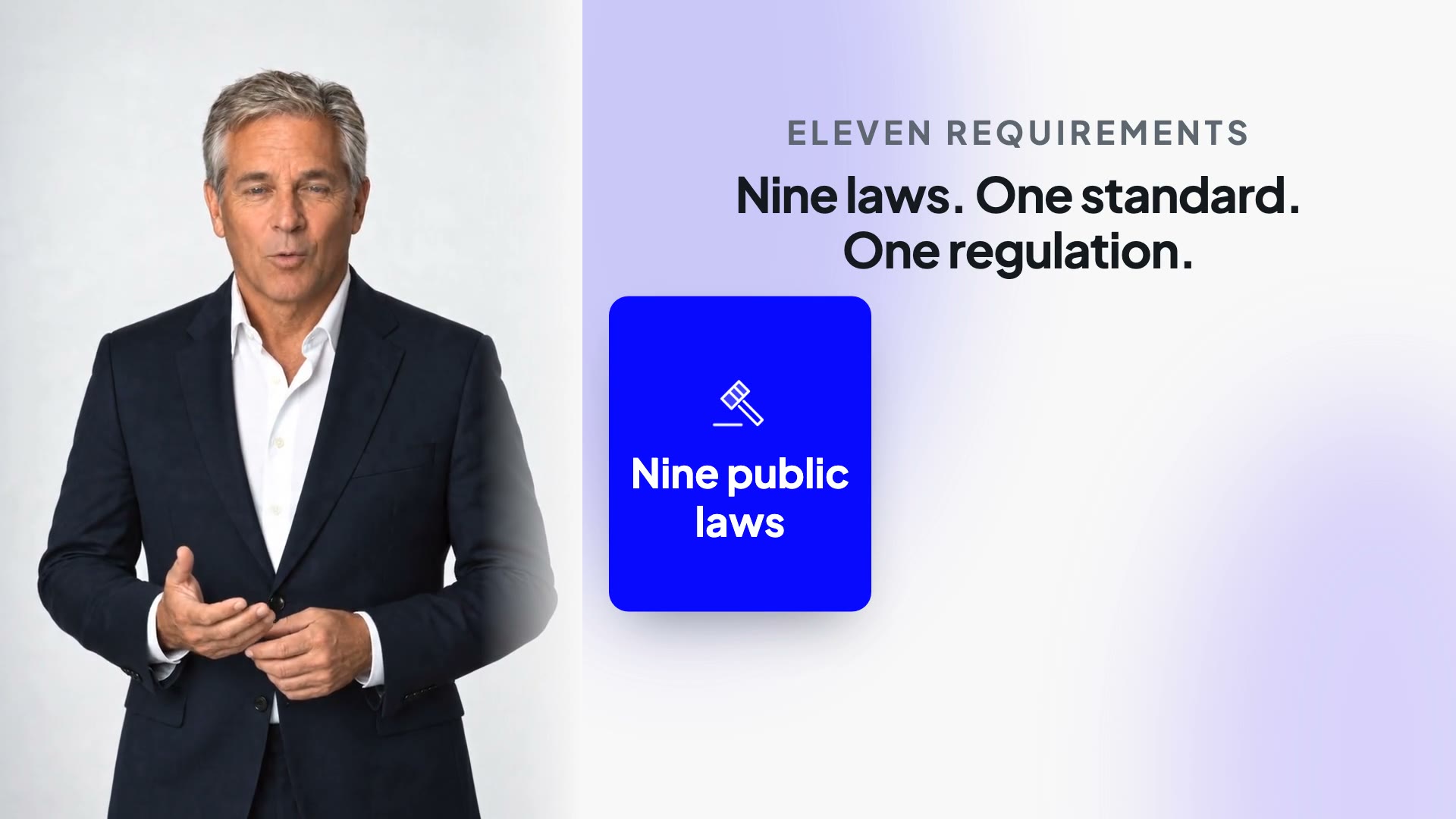
Eleven requirements · 1980 to 2023 · nine statutes, one standard, one regulation
Adoption Assistance and Child Welfare Act. P.L. 96-272. Case plan and status review at least every six months; dispositional hearing; the first federal court oversight of child-welfare cases.
Adoption and Safe Families Act. P.L. 105-89. Permanency hearing no later than 12 months after entry; initiate termination of parental rights once a child has been in care 15 of the most recent 22 months.
Chafee Foster Care Independence Act. P.L. 106-169. Outcome measurement and tracking of transition-age youth; became NYTD in October 2010.
Promoting Safe and Stable Families Amendments. P.L. 107-133. Reauthorized PSSF; created the Education and Training Voucher program for youth aging out.
Adam Walsh Child Protection and Safety Act. P.L. 109-248. Adds a fingerprint-based national check of prospective foster and adoptive parents, and child-abuse-registry checks of them and the other adults in the home in every state lived in for the prior five years, to the check the 1997 Act required; no state opt-out after October 1, 2008. No dedicated grant.
Monthly caseworker visit standard. Social Security Act §§422(b)(17), 424(f), from P.L. 109-288, strengthened by P.L. 112-34. Not less than 95% of required monthly visits. P.L. 118-258 §112(d) repealed the 50% in-residence rule and the funding penalties, effective October 1, 2025.
Fostering Connections to Success and Increasing Adoptions Act. P.L. 110-351. Due diligence within 30 days of removal to identify and notify adult relatives, with domestic-violence exceptions; kinship guardianship assistance and eligibility to age 21, both at state option.
Preventing Sex Trafficking and Strengthening Families Act. P.L. 113-183. Report a missing or abducted child to law enforcement for NCIC entry and to NCMEC within 24 hours; trafficking identification; the reasonable and prudent parent standard.
Family First Prevention Services Act. P.L. 115-123, Div. E, Title VII. Title IV-E funds for in-home prevention; congregate-care reimbursement capped at 14 days absent a QRTP designation; background checks for all adults working in group homes and other child-care institutions, unless the state reports the alternative checks it runs.
Trafficking Victims Prevention and Protection Reauthorization Act of 2022 (signed January 5, 2023). P.L. 117-348, §137. Adds, where reasonably possible, a photograph, a physical description and endangerment information to the reports to law enforcement and NCMEC, and a duty to maintain regular communication with both in efforts to provide a safe recovery.
Title IV-E eligibility review (regulation). 45 CFR §1356.71, final rule of January 2000. Periodic federal review of state claims to validate accuracy, verify licensing and recover improper payments; non-compliance triggers Program Improvement Plans and disallowances.
Sources: the public laws cited; SSA §§422(b)(17), 424(f); 45 CFR §1356.71.
Federal law is already moving from the snapshot to the ongoing obligation. That is exactly the shift a verification platform makes operationally possible.
Each requires the state to demonstrate that a specific thing happened, on a specific date, for a specific child. Every one of them is a timestamp problem: not a policy problem, not a training problem, and not a question of whether the state agrees with the requirement.
Five duties with a provable event
Each requires the state to demonstrate that a specific thing happened, on a specific date, for a specific child. Not a policy problem, not a training problem.
What follows is what happens when that evidence is generated manually, self-reported, and reconstructed after the fact. Sources: 42 U.S.C. §671(a)(35)(B); P.L. 117-348 §137; SSA §§422(b)(17), 424(f) as amended by P.L. 118-258; 42 U.S.C. §671(a)(20); 45 CFR §1356.71.
What follows is what happens when that evidence is generated manually, self-reported, and reconstructed after the fact.
© 2026 Federal Compliance Systems, Inc. All rights reserved.