The record, as it is made
Every federal requirement, verified as it happens
Case notes and placement records stay in the state’s case-management system. This record is the proof beside them.
Listen to this page 4 min
Loading the Elevenlabs Text to Speech AudioNative Player...
Part 5 of 5 · The Foster Care Compliance Gap
Every requirement, verified as it happens
What the auditors said was missing
Walk me through it · about three minutes
Five requirements. What states do today, and what verified looks like.
11
federal requirements, each an event with a date
4
facts per visit: which child, where, when, by whom
Same day
a missed check-in reaches the agency, not at the next visit
Five requirements, what states do today against each, and the record made at the moment it happens.

Identity enrolledA real-time photo ties the child to the record.

Presence capturedBiometric photo and GPS at the caregiver’s home.

Visit verifiedWhich child, where, when, by whom, appended at the door.
Illustrative screens of the system as designed.
Every federal requirement
Verified as it happens.
- Missing child: 24-hour report42 U.S.C. §671(a)(35)(B)What states do todayManual, self-reported, reconstructed after the fact. OIG estimates 69% of missing-child episodes were not reported to NCMEC as required.Foster Care Compliance System, as designedA failed check-in flagged to the agency the same day, with a time-stamped record.
- Communication through recoveryP.L. 117-348 §137What states do todayNo standard mechanism for demonstrating continuous contact.Foster Care Compliance System, as designedA dated communication log per episode, not a single filed report.
- Monthly caseworker visitsSSA §§422(b)(17), 424(f) · 95% of required visitsWhat states do todayCaseworker-entered records. Reported compliance 47 to 99% in FFY2012.Foster Care Compliance System, as designedDate-, time- and GPS-verified check-ins that establish the visit occurred, and where.
- Checks before placement42 U.S.C. §671(a)(20) · fingerprints for the parents, registry checks for every adult in the homeWhat states do todayRescreened from scratch per placement, funded by a patchwork of state, county and applicant dollars.Foster Care Compliance System, as designedIdentity verified once and reused across placements and agencies; each agency decides which checks it accepts.
- Every IV-E claim45 CFR §1356.71 · licensed placement, eligible periodWhat states do todayDocumentation assembled retrospectively for audit. No full national error rate since FY2020.Foster Care Compliance System, as designedContemporaneous, per-claim evidence of licensing and eligibility.
Capabilities are FComply’s description of the system as designed; the Foster Care Compliance System is an active concept that FComply is building with developers and investors. CCWIS modernized how caseworker entries are recorded; it did not create independent verification that the recorded event happened.
The five requirements, side by side, as first written
| Federal requirement | What states do today | Foster Care Compliance System, as designed |
|---|---|---|
| Report a missing child within 24 hours 42 U.S.C. §671(a)(35)(B) |
Manual, self-reported, retrospectively reconstructed. OIG estimates 69% of missing-child episodes were not reported to NCMEC as required. | A failed check-in flagged to the agency the same day, with a time-stamped record. |
| Ongoing communication through recovery P.L. 117-348 §137 |
No standard mechanism for demonstrating continuous contact. | A dated communication log per episode, not a single filed report. |
| Monthly caseworker visits, 95% of required visits SSA §§422(b)(17), 424(f) |
Caseworker-entered records. Reported compliance 47 to 99% in FFY2012. | Date- and time-stamped, GPS-verified check-ins that independently establish that the visit occurred, and where. |
| Checks of the parents and every adult in the home before approval 42 U.S.C. §671(a)(20) |
Rescreened from scratch per placement, funded by a patchwork of state, county and applicant dollars. | Identity verified once and reused across placements and agencies; each agency decides which checks it accepts. |
| Licensed placement and eligible period for every IV-E claim 45 CFR §1356.71 |
Documentation assembled retrospectively for audit. No full national error rate since FY2020. | Contemporaneous, per-claim evidence of licensing and eligibility. |
When a child cannot be produced
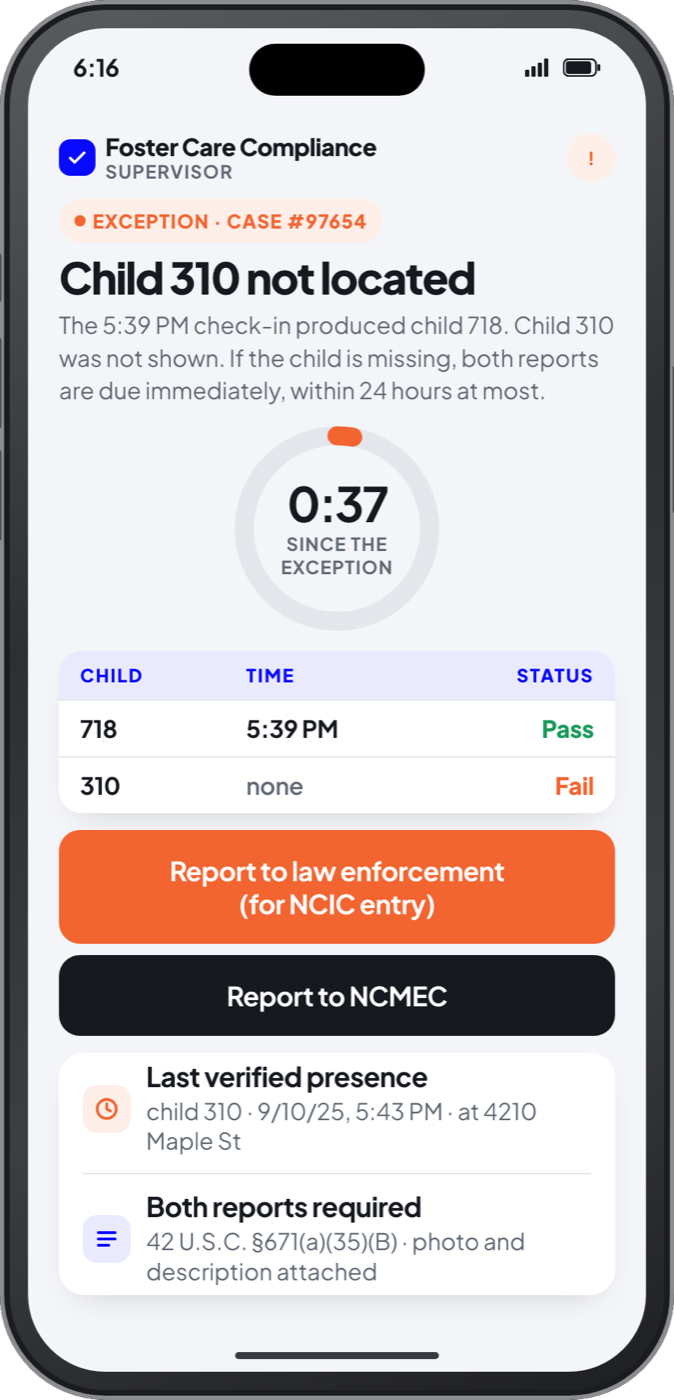
The exception, the same dayFComply says a missed check-in reaches a supervisor the same day, so staff can follow up without waiting for the next visit. The 24-hour report runs from when the agency receives information that a child is missing.

Resolved, with the record keptBoth statutory reports, the photograph and the description, one tap each.
Illustrative screens of the system as designed.
Avoided disallowances, litigation exposure that turns on proof, and one identity verified once instead of at every placement.
40
rise in per-child administrative cost in four years while the number of children served fell
5
years since the last full national foster-care improper-payment estimate (FY2020)
1
verified identity, designed to be reused across placements to lower total screening cost
What verification is worth, as first written
Disallowances and withholdings can run to hundreds of thousands of dollars in a single state review; litigation and consent-decree exposure turns on whether the state can prove it did what was required; per-child administrative cost rose 40% in four years while the number of children served fell; and verifying identity once, then reusing it, is designed to lower total screening cost. No validated dollar figure for avoided cost exists yet, because the federal government has not fully measured the improper-payment rate this would reduce since FY2020. Every cost above is currently paid, recurring and documented, and each traces to an evidentiary failure rather than a policy disagreement. A pilot with agreed baseline measures is the way to produce the number; how it would roll out and the return set out the clock and the ledger.
The visit is the record
The auditor reads what happened, when
Every figure on this page is traced to the document it comes from, with the supporting sentence quoted, in Supporting material.
- HHS/ACF Children’s Bureau, AFCARS Dashboard, preliminary FFY2025 estimates as of February 27, 2026.
- HHS OIG A-07-21-06102 (March 2023) and A-07-21-06104 (May 2023); A-03-06-00564 (2007); PIIA compliance reviews FY2021 (A-17-22-52000) through FY2025 (OAS-26-17-042, August 2026); HHS Annual Performance Plans (national foster care error rates to FY2020).
- GAO-03-357 and GAO-03-809 (2003); GAO-12-312 (March 2012); Comprehensive Child Welfare Information System final rule, 81 FR 35449 (June 2, 2016).
- NCMEC, Missing from Care; Senate testimony of Dr. Samantha Sahl, NCMEC, on Georgia.
- ACF monthly caseworker visit standards and federal data; P.L. 118-258 §112(d) (January 4, 2025), which repealed the 50% in-residence visit rule and the related funding penalties from October 1, 2025; Congressional Research Service, R41860, Table G-1 (October 2014), from ACF data; Missouri Department of Social Services CFSR data, FFY2008; ACF West Virginia Title IV-E primary review, 2024.
- Fifth Circuit opinion No. 24-40248; HHS Departmental Appeals Board Decision No. 2734 (2016); Bloomberg Law; Dallas Morning News.
- HHS/ASPE, Administrative Costs Drive Foster Care Claims, FY2019–FY2023 (Feb. 2026); Bipartisan Policy Center, Title IV-E FY2023 breakdown; child-welfare agency financing survey, state FY2022.
- 45 CFR §§1356.60, 1356.71; ACF Child Welfare Policy Manual §8.1; P.L. 103-209 §4; 34 U.S.C. §40103(b)(2); CMS NBCP materials; HHS OIG NBCP Final Assessment (Nov. 2024).
- Child Welfare Information Gateway, background checks for prospective foster, adoptive and kinship caregivers (2018); RCW 43.43.837; Missouri Children’s Division CD-26a; California CDSS fee schedule; San Diego HHSA policy manual; Texas DFPS; FDLE fee schedule (Jan. 2025); Utah State Legislature Fiscal Note HB0036S01.
- ACF/OPRE, Reasons for Child Welfare Caseworker Turnover from 2021 to 2022, OPRE Report #2025-009 (February 2025); ACF/OPRE, Snapshot of the Child Welfare Workforce from 2021 to 2022, OPRE Report #2025-040 (June 2025); Child Welfare League of America standards; Texas Sunset Advisory Commission, DFPS Staff Report (May 2014); U.S. Bureau of Labor Statistics, OEWS May 2025.
Held off this page: the fee policies of Maine, Rhode Island, New York and Mississippi, whose published fees concern child-care licensing rather than foster care. The turnover cost and the paperwork hours, once held, are now traced to a Texas Sunset Commission report and a federal OPRE study. Corrections to info@fcomply.com.
Protect the vulnerable and build trust at scale.
© 2026 Federal Compliance Systems, Inc. All rights reserved.