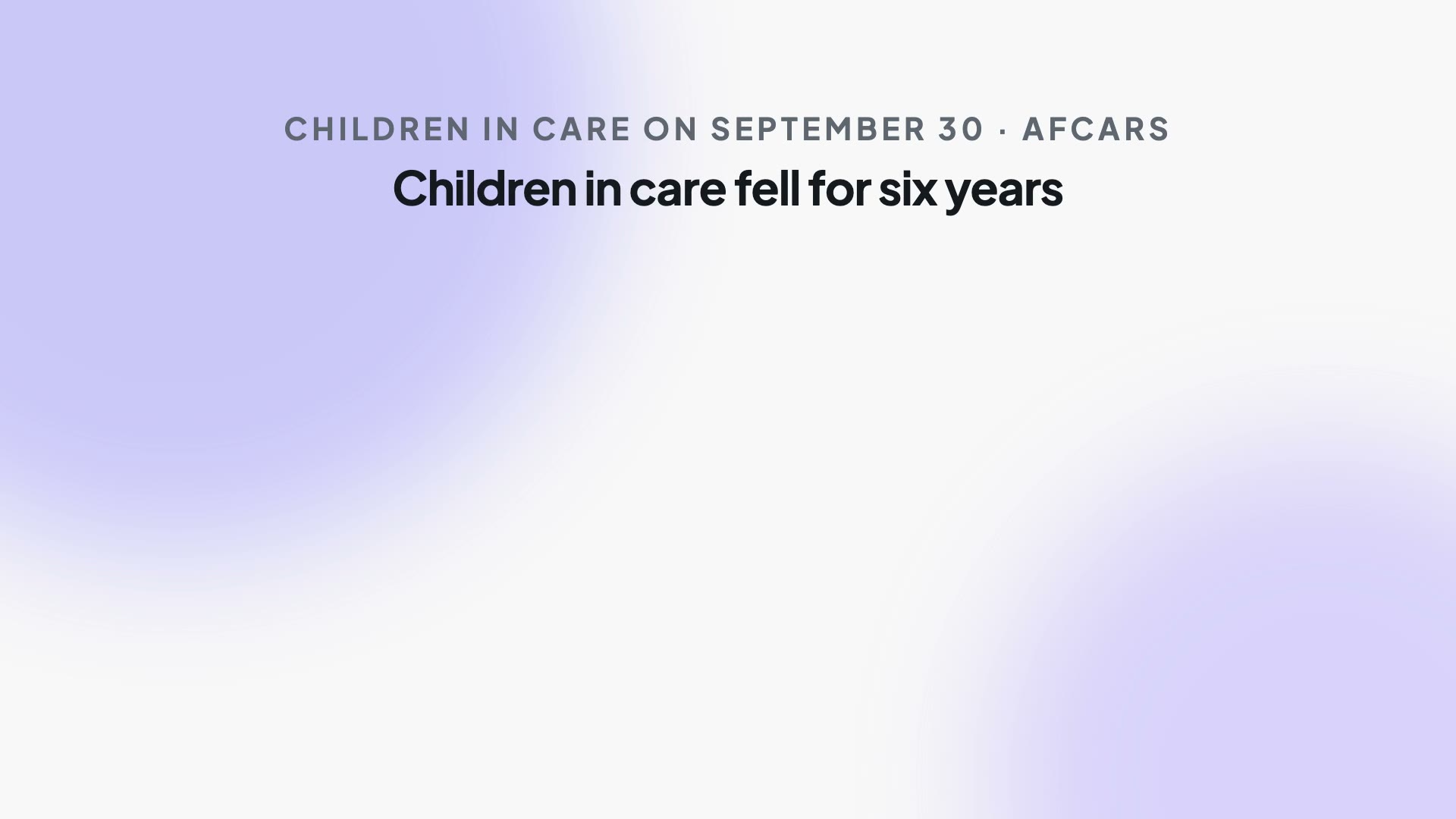
ACF’s AFCARS dashboard, federal fiscal year 2025, preliminary estimates as of February 27, 2026. Counts include ages 0 to 23 and are subject to revision.
Eleven requirements. One missing capability.
Congress has told states to review cases, hold permanency hearings, visit children monthly, screen every adult in the home, report a missing child within 24 hours and claim only eligible dollars. States dispute none of it. What they cannot do is prove, at the time and independently, that each happened for each child on each date.
Listen to this page 3 min
Loading the Elevenlabs Text to Speech AudioNative Player...
Every requirement is a timestamp problem
An estimated 7 in 10 missing-child episodes not reported to NCMEC as required
Walk me through it · about three minutes
A twenty-four-hour duty, assigned to a role with high turnover.
The compliance gap, in five parts
Part 1Eleven requirements11federal requirements, 1980 to 2023Read part 1 →Part 2Where compliance breaks47%of episodes never reported to NCMEC, by OIG’s estimateRead part 2 →Part 3What the gap costs$786,971in federal funds, disallowed after one state’s 2024 reviewRead part 3 →Part 4Who pays for screening0dedicated federal programsRead part 4 →Part 5The adequate systemSame daya missed check-in reaches the agencyRead part 5 →
331,747
children in foster care on September 30, 2025
175,008
entered foster care during FFY2025
169,927
exited foster care during FFY2025
501,745
served by the system across the full fiscal year
Children in care on September 30 · FY2020 to FY2025
FY2020
407,332
FY2021
391,641
FY2022
368,530
FY2023revised by ACF from 343,077
339,309
FY2024
327,364
FY2025preliminary; Washington’s first AFCARS 2020 data
331,747
One caution on the trend: the FY2025 rise is a reporting-population change as much as a caseload change, and AFCARS 2020 reporting began in FY2023, so earlier counts are not strictly comparable. Source: HHS/ACF Children’s Bureau, AFCARS Dashboard.
The workforce that has to do the complying
A 24-hour duty assigned to a role with high turnover
Average caseloads well above the recommended level
Compliance capacity
- No federal headcountBLS estimates 392,550 child, family and school social workers (May 2025), a category that includes school social workers. There is no complete federal count of child-welfare caseworkers.
- Turnover is structural53.3% of supervisors reported turnover had increased from March 2019 to June 2022 (ACF/OPRE, NSCAW III). GAO estimated 30–40% annual turnover with tenure under two years in 2003 (GAO-03-357); dated, but directionally consistent.
- Caseloads above the standardThe Child Welfare League of America’s standard is 12 to 15 children per caseworker. In the federal NSCAW III workforce study (2021–22), caseworkers reported an average of 22.4 children, a median of 16.9, and a range up to 99.
- Fragmented by designState- and county-administered under Title IV-B and IV-E across 50 states, D.C. and Puerto Rico; California, Ohio and New York run county systems with dozens to hundreds of local offices.
Compliance failures downstream are not primarily failures of will. They are what happens when a legal duty with a 24-hour clock is assigned to a role with high turnover that carries more than its recommended caseload.
The workday, and what a departure costs
- 4.3 of 8 hoursthe average a caseworker spends on paperwork and documentation in an eight-hour day (median 3.7 hours) · OPRE, NSCAW III workforce snapshot, June 2025
- $54,000 per departureTexas DFPS’s own estimate of what each caseworker who leaves costs the agency; 1,346 left in fiscal 2013, a $72.7 million impact · Texas Sunset Advisory Commission, May 2014
More than half the day goes to the record, and the record still cannot prove the visit happened. Verification at the moment of the event is also a caseworker-time question.
Sources: U.S. Bureau of Labor Statistics, OEWS May 2025; GAO-03-357 (2003); ACF/OPRE, Reasons for Child Welfare Caseworker Turnover from 2021 to 2022, OPRE Report #2025-009 (February 2025); ACF/OPRE, Snapshot of the Child Welfare Workforce 2021–2022, OPRE Report #2025-040 (June 2025); Child Welfare League of America standards; Texas Sunset Advisory Commission, DFPS Staff Report (May 2014).
Every state, the District of Columbia and five territories run the same federal requirements through their own statutes, systems and fee schedules. The federal floor is the same everywhere; the map shows where the state rules have been read at source so far.
4 of 50 states cited at source, September 2026
- state instrument read at source
- named by a congressional investigation (Georgia)
- in progress
The federal floor is the same everywhere: report a missing child to law enforcement and to NCMEC within 24 hours. States add their own statute, policy and practice on top.
Cited in this release: Washington, California, Minnesota and Georgia; Illinois and Colorado are under review. The remaining states are being read at source and will be added as they are verified.
What does federal law actually require of a state foster-care agency? Eleven requirements imposing specific duties, from the Adoption Assistance and Child Welfare Act of 1980 to the Trafficking Victims Prevention and Protection Reauthorization Act of 2022 (signed January 5, 2023): nine public laws, one statutory standard in the Social Security Act (monthly caseworker visits) and one federal regulation (Title IV-E eligibility reviews). Five of them attach a provable event to a clock.
Is there a federal grant that pays for foster-parent background checks? No. The Adam Walsh Act mandate rides entirely on the general 50% Title IV-E administrative match; Congress attached no appropriation to it. The National Background Check Program funded state checks of long-term-care workers, and foster homes were not among the provider types it listed. The same federal mandate therefore produces different answers to who pays: Washington and Missouri pay for foster applicants by statute or policy; California and Texas split it by county or placement type; Florida leaves it to the applicant or the placing agency.
Why not just improve the case-management system? The 2016 CCWIS rule modernized how caseworker entries are recorded. It did not create independent verification that the recorded event happened. Self-reported data entered into a modern system is still self-reported data. GPS and timestamps are not a better data-entry field; they are a different category of evidence, and they sit beside the case-management system rather than in place of it. What that looks like, requirement by requirement, is the adequate system.
Protect the vulnerable and build trust at scale.
© 2026 Federal Compliance Systems, Inc. All rights reserved.