The promise cannot be “national in two years”. It is verified results in pilot states eighteen months after the pilot starts, a repeatable state onboarding by year three, and a majority of children in care covered by year five to seven, at state procurement pace, not at a vendor’s build pace. Every date below counts from the start of readiness.
How it would roll out: the honest clock
Three questions follow every conversation about fixing this: how long would it take, how would it work across fifty states, and how do you keep it from becoming one more program that fades. Here is the answer, with the benchmarks that set it.
Listen to this page 2 min
Loading the Elevenlabs Text to Speech AudioNative Player...
Pilot results 18 months after it starts
Laws and money alone took 7 to 20 years
Walk me through it · about three minutes
What the operator runs. What the state keeps. And the clock, honestly.

Four phases from readiness to national availability, set against the seven to twenty years comparable systems took.
Four phases
Legal opinions in the candidate states on biometric-privacy statutes and consent; a security attestation; a privacy impact assessment; published measure definitions; a procurement vehicle for the pilot.
Twelve to eighteen months, after readiness. A defined cohort of children and caregivers. Proves enrollment coverage, check-in completion, time from exception to each statutory report, verified-visit rate, caseworker time, zero consent or biometric-law incidents, and cost per child-month — every measure against a pre-pilot baseline, with an independent audit of the record.
Eighteen to thirty months, after the pilot. A lead-state cooperative contract removes the separate procurement for later states. Proves that onboarding repeats across case systems, statutes and county- or state-administered models, and that a verified identity carries across organizations within a state, each of which still decides which checks it accepts.
Opens from month 36, while the cohort finishes. Remaining states, territories and tribes join at their own budget and procurement pace. Exit test: a majority of children in care covered, an annual independent audit, and a second national measurement of 24-hour compliance that moves from the 2018–2020 baseline.
Durations are planning assumptions. A cooperative contract is what makes the cohort phase possible.
Laws alone did not work
Each federal program below that asked states to build or adopt a system tells the same story. Coverage arrives seven to twenty years later, if at all. The record sets the clock for anyone who claims they can do better.
How long comparable systems took · 20-year scale
E-Verify1996 law → all states 2004
8 years
Electronic Visit VerificationCures Act 2016 → home health deadline 2023
7 years
National Background Check ProgramACA 2010 → 29 jurisdictions took part, 27 developed programs, ended May 2024
10+ years
FBI Rap Backcontinuous notification → 10 states enrolled, July 2025
~10 years
CCWIS (child-welfare systems)2016 rule → under a third of projects operational
10 years, unfinished
REAL ID2005 Act → enforcement May 2025
20 years
FComply · readinesslegal opinions, candidate states
months 0–9
Pilot, 1–2 statesresults 18 months after it starts
to month 27
6–10 state cohortaudited states early
to month 57
National availabilityat each state’s pace; durations are planning assumptions
year 7
Sources: E-Verify history (e-verify.gov); CMS Electronic Visit Verification guidance and FAQ (medicaid.gov); HHS-OIG OEI-07-24-00100, National Background Check Program final assessment (November 2024); SEARCH, States Make Steady Progress Toward FBI Rap Back Implementation (July 2025); HHS/ASPE, CCWIS Implementation Shows Minimal Progress (June 2026); 6 CFR 37.5, REAL ID enforcement (May 2025). The FComply phases are planning assumptions, not commitments.
One ask first: finish the 2018 national check program. Then four decisions inside authority that already exists, and five sets of hands. A second film walks them.
Walk me through it · about three minutes
Nothing here needs a new law. It needs four decisions and a lot of signatures.
FComply’s ask, then four proposals · for discussion
- Finish the 2018 programthe President directs the Attorney General to issue the final rule for the national check program Congress ordered in 2018 (34 U.S.C. §40102(f)), proposed in August 2023 and still not final; FComply intends to compete to be one of the designated entities that run its checks
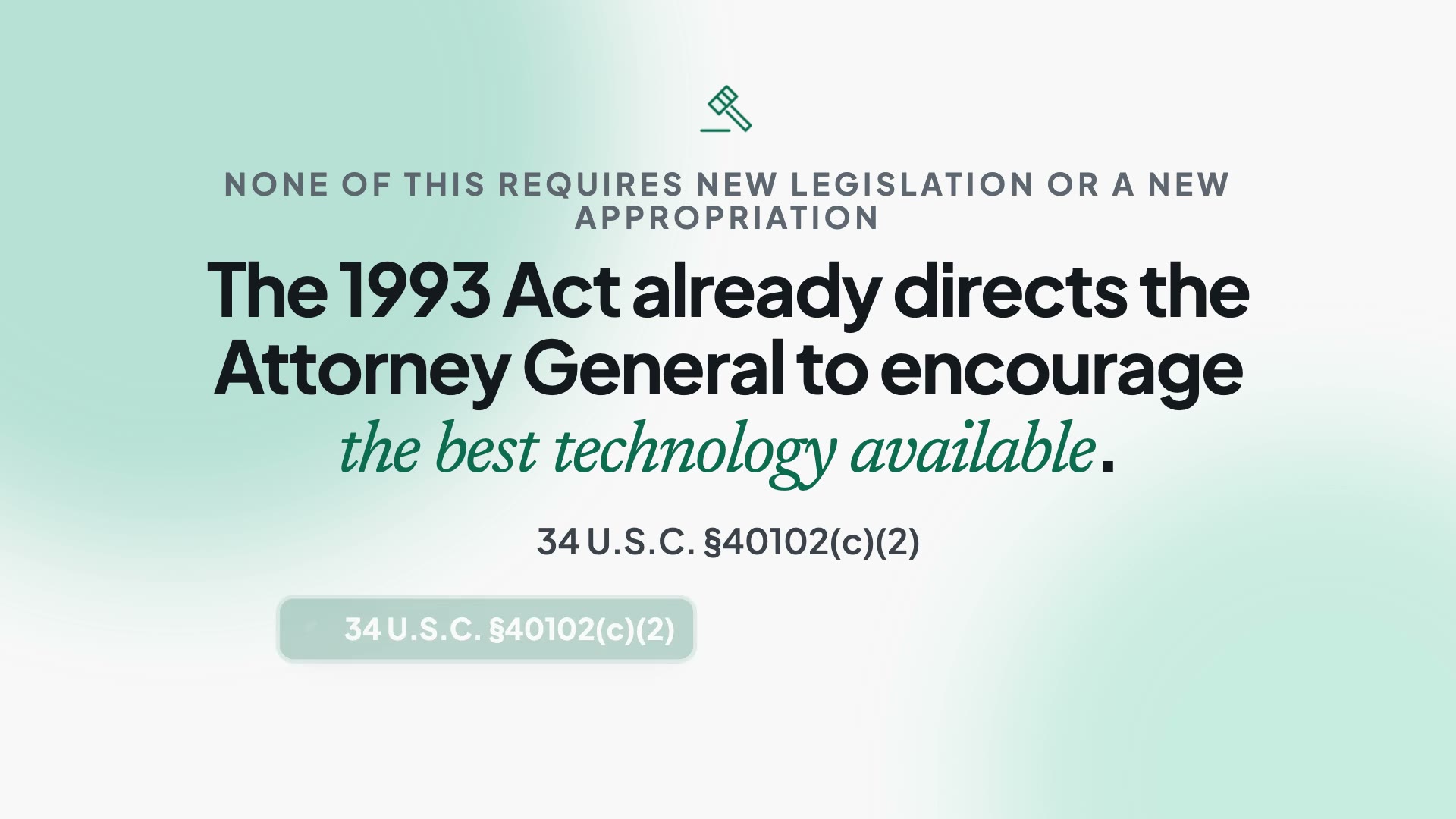
- Recognize the standardidentity-verified, continuously monitored screening as the “best technology available” under §40102(c)(2), through guidance, a technology standard or a published statement of position
- Support a limited pilota defined set of qualified entities across at least two of the three protected populations, with agreed evaluation measures and a public report at its conclusion
- Open a path to continuous monitoringthe FBI’s Rap Back service already provides the notification this problem needs; examine whether and how vetted qualified entities can be brought within it
- Convene the agenciesACF, CMS and BJS each own a piece of this and no one owns the whole; one table, at the Department’s invitation
What this does not ask for: a new law, a new federal mandate on employers, preemption of state fitness determinations, or an endorsement of any single vendor. FComply intends to compete for designation like any other applicant.
FComply’s ask and proposals, for discussion. Statutory basis: 34 U.S.C. §40102(c)(2) and (f), the Child Protection Improvements Act of 2018; the Justice Department’s proposed rule, 88 FR 58167 (August 25, 2023); FBI Next Generation Identification, Rap Back Service.
Finish the 2018 rule
Judged by the auditors’ own standard
Legal, technology and procurement offices may each need to say yes, not only the program office; eighteen months into the pilot, the state holds measurements set against a baseline.
The gates that decide credibility
The general counsel, the chief information officer and procurement each have a question, and each has an answer the operator must be able to hand over.
Biometric privacy
Illinois, Texas, Washington and Colorado regulate biometric data by statute; children raise the bar.
Turn overEvery pilot state gets a statute-by-statute legal opinion. The operator shows its consent architecture — who consents for a child in care and how it is recorded — a written retention and destruction schedule, template-not-image storage where possible, and an incident plan.
Turn backSecurity and records law
The FBI CJIS Security Policy, a SOC 2 report and, where a state requires it, GovRAMP on one side; the confidentiality of foster care records on the other. FComply is working toward these and holds none of them yet.
Turn overCriminal-history results go only to the organization the law allows to receive them, and FComply would keep them no longer than the FBI’s rules allow. The agency owns the record. FComply is designed to act as the agency’s processor, with a data inventory, role-based access and nothing kept beyond what proves an event.
Turn backProcurement and funding
Competition is the norm; federal money is state by state.
Turn overSole-source needs written justification; cooperative contracts let later states piggyback. Title IV-E reimburses administration at 50% and training at 75%; CCWIS functions at 50% with federal prior approval above set thresholds. No federal appropriation exists today for a national operator — a funding memo per state shows what each line covers.
Turn backEighteen months into the pilot
A pilot state gets measurements, each one set against a baseline taken before the pilot began.
- Children enrolled as a share of children in care, and check-in completion by month.
- Median and 90th-percentile time from an exception to each statutory report — law enforcement and NCMEC.
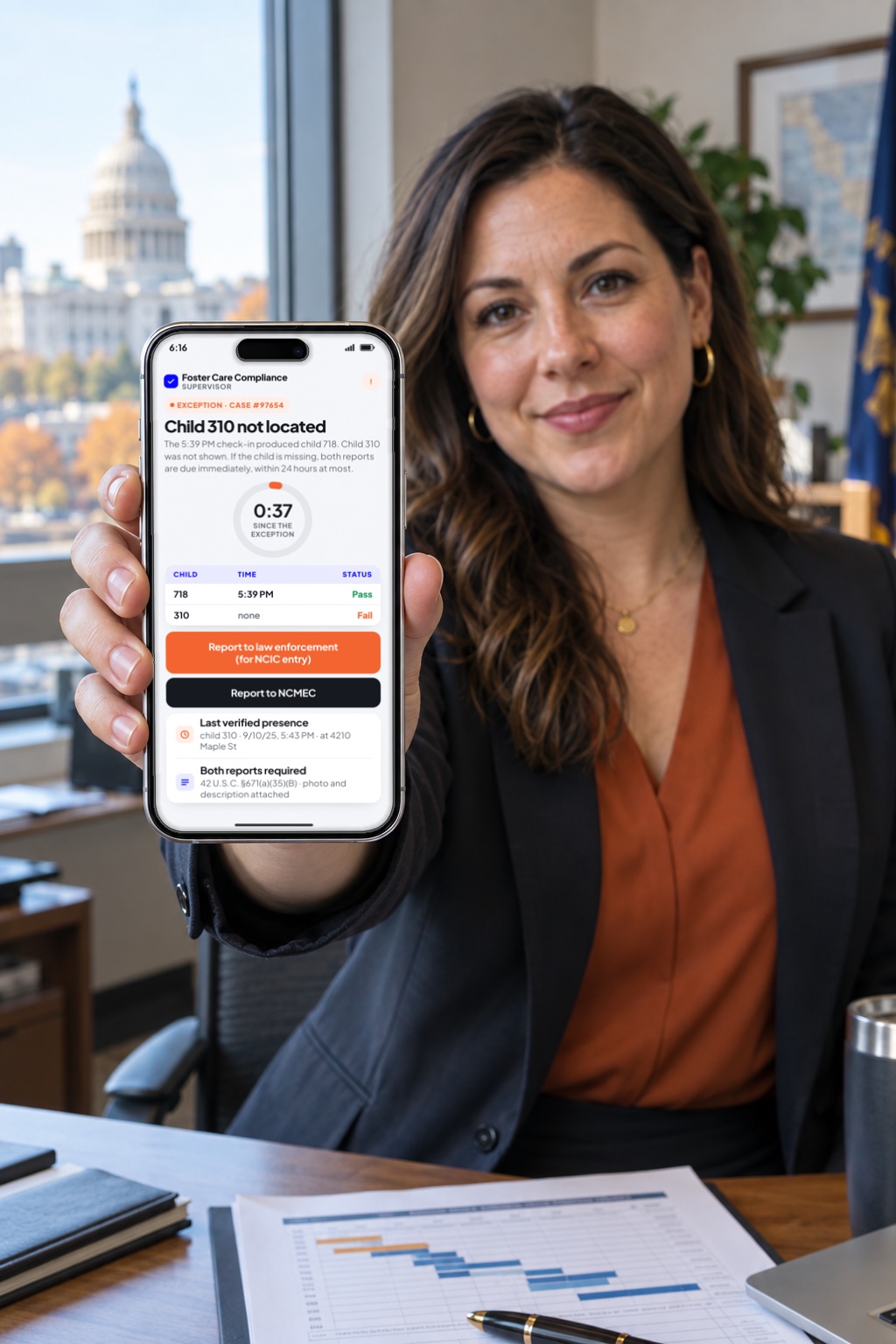
- Share of missing episodes reported within 24 hours to both legs, against HHS-OIG’s estimated 2018 to 2020 baselines, by its calendar-day test: 31% reported on time to NCMEC, 81% to law enforcement for NCIC.
- Verified monthly-visit rate and in-home share, from verified visits rather than completed forms.
- Caseworker minutes per visit and per record, before and after.
- Failed-match rate and resolution time; zero consent or biometric-law incidents; data held per child, in fields and days.
- Cost per child-month, with the federal share shown.
Within 24 hours, both legs
Estimated baseline 31% NCMEC · 81% law enforcement
Read next: The return — where the money goes today and where the value comes from — or what this means for a state agency.
The auditors’ own standard
Same-day, not next month
Prepared September 2026 from public sources cited in the infographic. Assumptions are labeled as such.
The documents behind the figures on this page are listed in Supporting material.
Frequently asked questions
Does this replace the state’s case-management system (CCWIS)?
No. As designed, FComply would run beside it as a verification and record layer: enrollment, presence events, exceptions and the report packet. The state keeps its case system, its custody decisions and its data. That is also why the plan can move faster than a system rebuild — fewer than a third of CCWIS projects are operational after ten years.
Who actually makes the reports to law enforcement and NCMEC?
The agency does; the duty is the agency’s under 42 U.S.C. §671(a)(35)(B). As FComply designs the system, it raises the exception the same day, assembles the report packet — photograph, description, endangerment information — and logs the time of each report. Only law enforcement enters a child into NCIC.
Does FComply hold criminal records?
Federal criminal-history results are released only to recipients authorized under federal law, through state repositories, authorized agencies or FBI-approved channels. A compliance operator routes screening through those channels and records that a check was completed and is current; it is not a warehouse of records.
How long until national coverage?
None of the comparable systems on this page reached national coverage in under seven years; several never have. The credible promise is verified results in pilot states eighteen months after the pilot starts (about month 27, after nine months of readiness), a repeatable state onboarding by year three, and a majority of children in care covered by year five to seven — at the states’ own procurement pace.
Protect the vulnerable and build trust at scale.
© 2026 Federal Compliance Systems, Inc. All rights reserved.