
Every state works from the same two federal duties, and everything in the table is what a state adds on top of them. Four states are documented at source so far, with Illinois and Colorado under review, and each entry is dated on the day it was last checked.
Missing from care
The federal rule sets a floor. Each state adds its own statute, policy and agency practice, and some have been audited or investigated by name. This reference is being built out in stages; every entry is dated, and any entry still awaiting a source is marked.
Listen to this page 2 min
Loading the Elevenlabs Text to Speech AudioNative Player...
One federal floor, each state’s rules on top
Four states cited at source so far
Walk me through it · about three minutes
Four states cited at source, two under review. Every entry dated.

Protocols for locating children missing from care, and a report to law enforcement and to NCMEC within 24 hours.
Under 42 U.S.C. §671(a)(35), every state must (A) operate protocols for locating children missing from care, understanding why they left and what happened to them, and (B) report each missing or abducted child to law enforcement for NCIC entry and to NCMEC immediately and in no case later than 24 hours after receiving the information — with, since 2023, a photograph, description and endangerment information where reasonably possible. Compliance with the reporting duty was estimated from samples across 46 states by the HHS Office of Inspector General for July 2018 to December 2020; the results are here. The OIG also published a national snapshot of how state agencies approach reporting and locating children missing from foster care (A-07-20-06095, May 2022), which describes how their reported policies and procedures vary.
42 U.S.C. §671(a)(35)
Since 2023: photo and description
The floor, verified
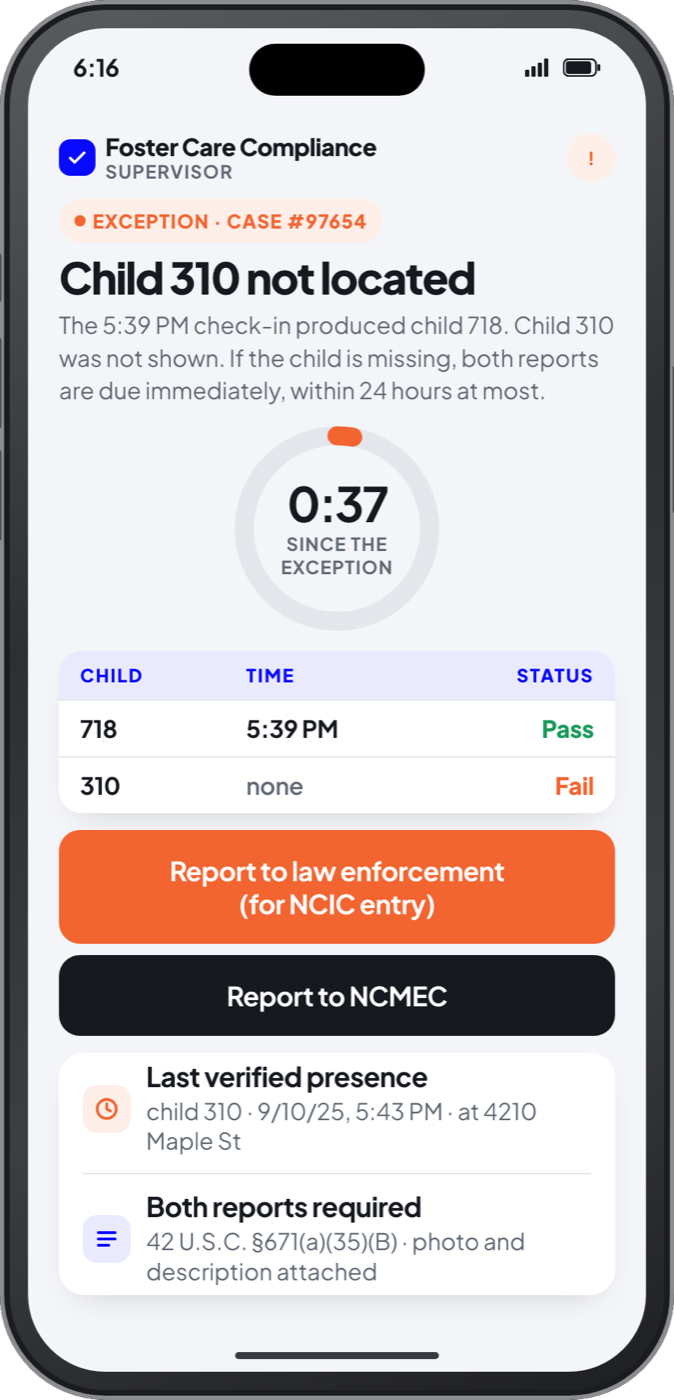
The report the floor requiresTo law enforcement and NCMEC, immediately and within 24 hours at most, with the photograph.

Kept for the state’s own ruleWhatever the state adds on top, the record is already there.
Illustrative screens of the Foster Care Compliance System as designed.

One federal floor
Each state’s rules on top
Georgia, Washington, Minnesota and California cited at source in September 2026; Illinois and Colorado under review; the rest in progress.
4 of 50 states cited at source, September 2026
- state instrument read at source
- named by a congressional investigation (Georgia)
- in progress
The federal floor is the same everywhere: report a missing child to law enforcement and to NCMEC within 24 hours. States add their own statute, policy and practice on top.
Cited in this release: Washington, California, Minnesota and Georgia; Illinois and Colorado are under review. The remaining states are being read at source and will be added as they are verified.
| State | State instrument | What it adds to the federal rule | Audit or investigation exposure | Checked |
|---|---|---|---|---|
| Georgia | Division of Family & Children Services (DFCS) policy on children missing from care (source pending) | Agency policy operationalizes the federal duty; details under review | U.S. Senate Human Rights Subcommittee investigation, 2023–2024: NCMEC analysis found more than 2,400 reports involving 1,790 children missing from DFCS care in 2018–2022, of whom 410 were identified by NCMEC as likely victims of child sex trafficking | Sep 2026 |
| Washington | DCYF Policy 4550, Children and Youth Missing from Care | Detailed agency procedure for reporting, searching and return; specifies the law-enforcement and NCMEC notifications and the internal steps around them | — | Sep 2026 |
| Minnesota | DCYF Bulletin #24-68-12, Children and youth missing from foster care: 2024 legislative changes | Statewide guidance to counties and tribes on reporting and response duties | — | Sep 2026 |
| California | County-level procedures under state guidance (e.g. Orange County SSA K-0214, Children / Non-Minor Dependents Missing From Care) | Extends procedures to non-minor dependents in extended foster care; county-by-county implementation | — | Sep 2026 |
| Illinois | DCFS administrative rules and procedures on missing children (source pending) | Under review | — | Sep 2026 |
| Colorado | Child Protection Ombudsman materials (source pending) | Under review | — | Sep 2026 |
| Remaining states: in progress. Each will be added with its instrument, timing and sources. To contribute a citation, write to info@fcomply.com. | ||||
“Federal baseline” in a row means no state instrument adding to the federal rule has been found yet, not that none exists. First release September 2026; a living document.

The state instrument, read at source
Different in every state
Sources for this section
Sources: Office of U.S. Senator Jon Ossoff (Chair, Senate Judiciary Subcommittee on Human Rights and the Law), foster care investigation releases of October 27 and November 6, 2023, including the NCMEC analysis of 1,790 children and 410 likely trafficking victims (ossoff.senate.gov: October 27, November 6); Washington State DCYF, Policy 4550 Children and Youth Missing from Care (dcyf.wa.gov); Minnesota Department of Children, Youth, and Families, Bulletin #24-68-12 Children and youth missing from foster care: 2024 legislative changes, August 20, 2024 (dhs.state.mn.us, PDF); Orange County (California) Social Services Agency, K-0214 Children/Non-Minor Dependents Missing From Care (ssa.ocgov.com, PDF); HHS-OIG, A-07-20-06095, National Snapshot of State Agency Approaches to Reporting and Locating Children Missing From Foster Care, May 2022 (full report, PDF); HHS-OIG, A-07-21-06102 and A-07-21-06104 (2023). Every figure on this page is traced to the document it comes from, with the supporting sentence quoted, in Supporting material (rows F7 and S2). Corrections and citations to info@fcomply.com.
Frequently asked questions
Why is the table not complete?
Because an incomplete entry that is right is more useful than a complete one that is guessed. Each state is added when its statute or policy has been read at source and dated. If your state is missing, send us the citation and we will add it.
Does a state policy override the federal rule?
No. The federal 24-hour duty is a condition of the state’s Title IV-E plan and applies everywhere. A state policy can be stricter or more detailed, but it cannot be looser.
What counts as audit exposure?
A federal or state audit, inspector-general review, legislative investigation or court monitor report that has examined the state’s handling of children missing from care by name. The national OIG audits drew on data from 46 states; their appendices give findings for each sampled state, but their compliance estimates cover the 46 states together, not any single state.
What patterns show so far?
In the states read so far, the differences are in agency procedures, added notifications, documentation and follow-up. Orange County, California, for one, has procedures for missing non-minor dependents in extended foster care. Georgia is a publicly documented example: a Senate subcommittee investigation requested NCMEC’s Georgia data and made it public in 2023, and those figures do not show that Georgia’s rate is the worst.
Protect the vulnerable and build trust at scale.
© 2026 Federal Compliance Systems, Inc. All rights reserved.