
One sentence of federal law, a condition of every state’s Title IV-E plan since 2016; three phrases in it do most of the work.
The 24-hour rule
When a child in foster care goes missing, federal law requires the state agency to tell law enforcement and the National Center for Missing and Exploited Children immediately, and no later than 24 hours after it receives that information. Here is what the statute says, who it covers, when it took effect and what changed in 2023.
Listen to this page
Loading the Elevenlabs Text to Speech AudioNative Player...
A glass clock on a pale blue floor, its blue hand turning, with lines of blue light running to two white blocks
Two reports, one clock
Immediately; 24 hours is the limit
Walk me through it · about three minutes
Three phrases in one sentence of federal law do most of the work.

The sentence itself, with the three phrases marked, and the two reports it requires from one clock.
One sentence of federal law
Three phrases do most of the work.
“… for each child and youth described in paragraph (9)(C)(i)(I) of this subsection1, the State agency shall report immediately, and in no case later than 24 hours after receiving2, information on missing or abducted children or youth to the law enforcement authorities for entry into the National Crime Information Center (NCIC) database of the Federal Bureau of Investigation … and to the National Center for Missing and Exploited Children3 … and that the State agency shall maintain regular communication with law enforcement agencies and NCMEC in efforts to provide a safe recovery of a missing or abducted child or youth …”
- 1Every child in the agency’s careEach child or youth for whom the state has responsibility for placement, care or supervision, including young adults where a state has extended foster care past 18.
- 2The outer limit, not the targetTwenty-four hours is the outer limit. The clock runs from the moment the agency receives the information, whoever inside the agency receives it.
- 3Two reports, not oneLaw enforcement, so the child is entered into NCIC; NCMEC separately, so its recovery resources are engaged. A police report does not create an NCMEC report.
The statute and the three points as first written
“… for each child and youth described in paragraph (9)(C)(i)(I) of this subsection, the State agency shall report immediately, and in no case later than 24 hours after receiving, information on missing or abducted children or youth to the law enforcement authorities for entry into the National Crime Information Center (NCIC) database of the Federal Bureau of Investigation … and to the National Center for Missing and Exploited Children … and that the State agency shall maintain regular communication with law enforcement agencies and NCMEC in efforts to provide a safe recovery of a missing or abducted child or youth …”
Three things in that sentence do most of the work.
- Two reports, not one. Law enforcement is notified so the child can be entered into NCIC, the FBI’s national database that police agencies nationwide can query. NCMEC is notified separately so its case-management, analysis and recovery resources are engaged. A police report does not create an NCMEC report.
- “Immediately, and in no case later than 24 hours.” Twenty-four hours is the outer limit, not the target. The clock runs from the moment the agency receives the information, whoever inside the agency receives it.
- Every child in the agency’s care. The cross-reference to paragraph (9)(C)(i)(I) names any child or youth in the state’s placement, care or supervision whom the state has reasonable cause to believe is, or is at risk of being, a sex trafficking victim, and it expressly includes children who have run away from foster care and are under 18, or under the older age a state has elected for extended foster care. HHS-OIG says the state plan requirements apply to every child in the state’s care, placement or supervision.
Leg one · law enforcement
- Hour 0The agency receives information that a child is missing. The clock starts here, whoever inside the agency receives it.
- Report to law enforcementSo the child is entered into NCIC, the FBI’s national database that police agencies nationwide can query.
- Hour 24 at the latest“Immediately, and in no case later than 24 hours.” The statute’s target is now; 24 hours is the outer limit.
Leg two · a separate report to NCMEC
- Hour 0The same moment, the same clock.
- Report to NCMECThe National Center for Missing & Exploited Children. A police report does not do this; it is a second, separate report.
- Hour 24 at the latestTwo reports, from one clock.
A separate duty, since 2023
- Regular communicationwith law enforcement and NCMEC until the child is recovered
An empty pool of warm light on a line of blue light, where a person should be standing
The clock starts when the agency learns
An estimated 47% never reported to NCMEC
Two acts of Congress, eight years apart: signed in 2014, binding since 2016, sharpened by P.L. 117-348 §137 in 2023.
The duty was written in 2014, took effect in every state plan by 2016, and was sharpened in 2023. Two acts of Congress, eight years apart, produced the rule as it stands.
2014 to 2023 · Where the rule came from
From a one-time report to an ongoing duty
Blue is what Congress enacted and when it took effect. Orange marks the 2023 amendment that turned a report into a duty of regular communication.
The statute
2014
Preventing Sex Trafficking and Strengthening Families Act
Public Law 113-183, signed September 29, 2014. Within one year, protocols for locating children missing from care, determining why they left, assessing what happened to them and deciding what to do, including screening for sex trafficking.
2 years after signing, the reporting duty applied
2016
In force in every state plan
The statute applies “not later than 2 years after September 29, 2014”; the duty has been in force since September 2016.
The amendment
2023
Trafficking Victims Prevention and Protection Reauthorization Act of 2022
Public Law 117-348, §137, signed January 5, 2023. Regular communication with law enforcement and NCMEC made explicit; each report to carry, where reasonably possible, a photograph, a physical description and endangerment information. (§136 is a sense-of-Congress provision; §137 is the operative amendment.)
The practical effect
A compliant report is no longer a phone call saying a child is gone. It is a structured notification that gives the people searching something to search with.
The two sections as first written
The requirement was added by the Preventing Sex Trafficking and Strengthening Families Act of 2014 (Public Law 113-183), signed on September 29, 2014. Congress gave states two years: the statute applies “not later than 2 years after September 29, 2014”, so the reporting duty has been in force since September 2016. The same paragraph, in subparagraph (A), required each state within one year to develop and implement protocols for locating children missing from care, determining why they left, assessing what happened to them while missing, and deciding what to do about it, including screening for sex trafficking.
Section 137 of the Trafficking Victims Prevention and Protection Reauthorization Act of 2022 (Public Law 117-348, signed January 5, 2023) amended subparagraph (B) in two ways. It made the duty to “maintain regular communication” with law enforcement and NCMEC explicit, including sharing information relevant to a safe recovery. And it specified what a report should contain, where reasonably possible: a photograph of the child; a physical description (height, weight, sex, ethnicity, race, hair and eye color); and endangerment information such as pregnancy, prescription medications, suicidal tendencies, vulnerability to sex trafficking and other health or risk factors. (Section 136 of the same Act is a sense-of-Congress provision; the operative amendment is Section 137.)
The practical effect is that a compliant report is no longer a phone call saying a child is gone. It is a structured notification that gives the people searching something to search with.

42 U.S.C. §671(a)(35)(B)
In force in every state plan since 2016
The 2023 report, on the phone
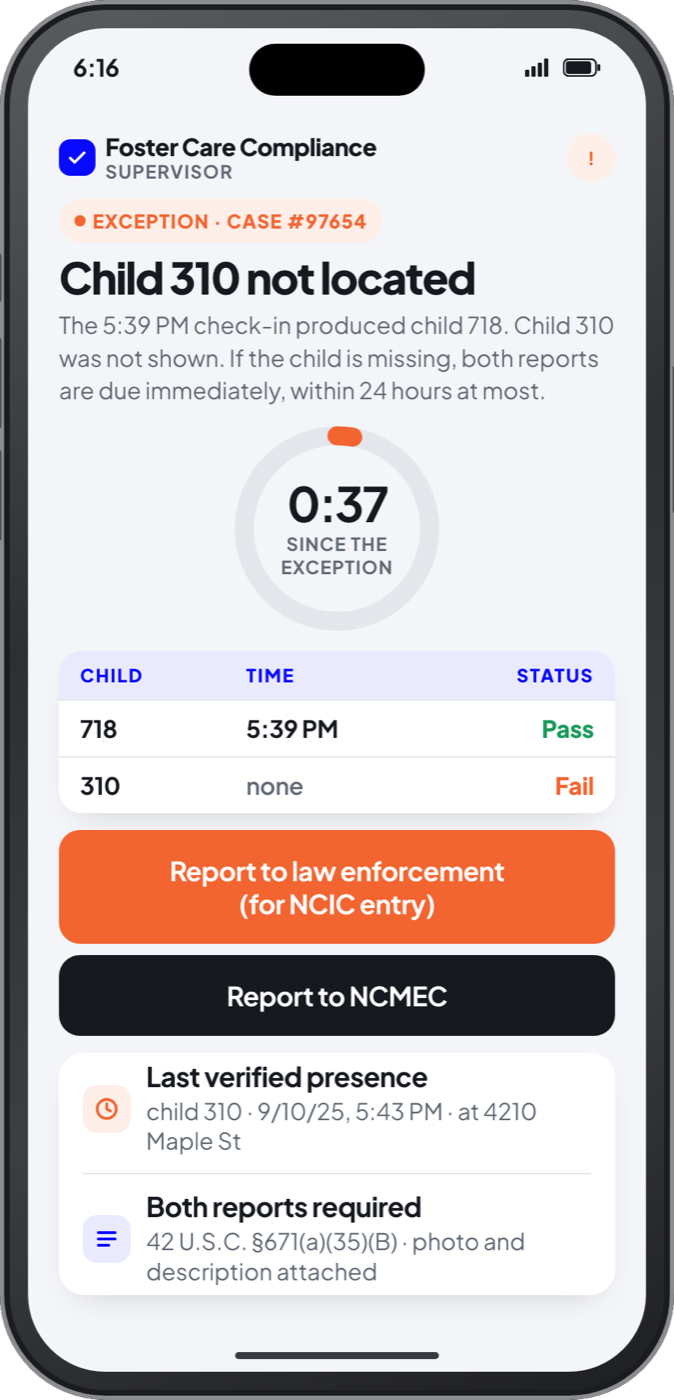
Photograph, description, endangerment informationWhat §137 asks for, attached to the report itself.

Regular communication until recoveryThe record shows who was told, and when.
Illustrative screens of the Foster Care Compliance System as designed.
None of this works if the agency does not learn quickly that a child is missing.
What a started clock looks like


The check-in that did not happenThe agency knows the same day, rather than at the end of the month.


Who is told, and in what orderCaseworker and foster parent first, then law enforcement and NCMEC, the two recipients the statute names.
Illustrative screens of the Foster Care Compliance System as designed. The system is an active concept that FComply is building with developers and investors.
As FComply designs it, the Foster Care Compliance System verifies a child’s presence with biometric photo capture and GPS at check-ins, and logs caseworker visits with a time and location, so a child who cannot be produced is a same-day exception rather than a discovery at the next monthly visit, and the record of when the agency knew is created automatically. The system is an active concept that FComply is building with developers and investors. How that works for a state agency is set out here.
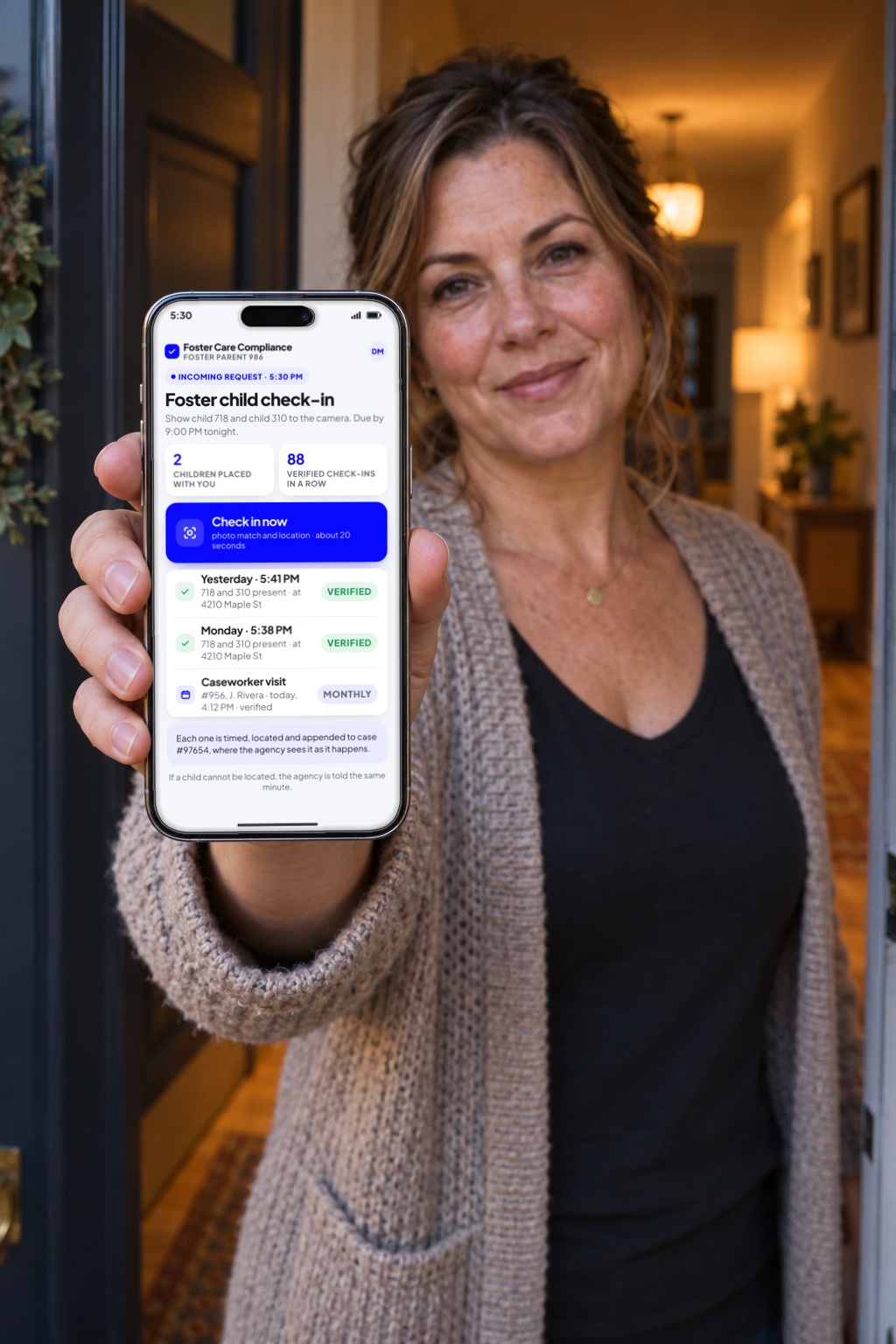
A short check-in at the door
Designed to flag a missed check-in the same day
A clock on a pale blue floor beside a phone whose alert card lifts off the screen
A same-day exception
When the agency knew, recorded
Sources for this section
Sources: 42 U.S.C. §671(a)(35), Legal Information Institute, Cornell Law School (law.cornell.edu/uscode/text/42/671); Preventing Sex Trafficking and Strengthening Families Act of 2014, Public Law 113-183 (September 29, 2014); Trafficking Victims Prevention and Protection Reauthorization Act of 2022, Public Law 117-348, §137 (January 5, 2023) (congress.gov); NCMEC, Children Missing from Care and Frequently Asked Questions of Social Service Agencies (missingkids.org/theissues/missingfromcare); HHS-OIG, A-07-21-06102, March 2023, pp. 4 to 5 (full report, PDF), for the 47% estimate, the two-calendar-day episode length and the two-calendar-day late-report rule. Every figure on this page is traced to the document it comes from, with the supporting sentence quoted, in Supporting material (rows F5 and S12). This guide is a plain-English explanation, not legal advice; it was last reviewed in September 2026, and corrections go to info@fcomply.com.
Frequently asked questions
Does a police report satisfy the rule on its own?
No. The statute requires two reports: one to law enforcement so the child is entered into the FBI’s NCIC database, and a separate one to NCMEC. NCMEC’s own guidance to agencies notes that a report to law enforcement does not automatically generate a report to NCMEC.
When does the 24 hours start?
On receiving information that the child is missing or abducted, not at the next scheduled visit, the next business day, or when an internal review concludes. The statute says “immediately, and in no case later than 24 hours after receiving” the information.
Who is covered?
Every child or youth for whom the state agency has responsibility for placement, care or supervision under its Title IV-E plan. Where a state extends foster care to young adults, they are covered too.
Is there a minimum time missing before it counts?
The statute sets none. The OIG audits reviewed episodes of two calendar days or longer, but the reporting duty attaches when the agency learns the child is missing.
Protect the vulnerable and build trust at scale.
© 2026 Federal Compliance Systems, Inc. All rights reserved.