The federal duties below all rest on the same two facts: you have to know who your caregivers are, and you have to know where each child is.
For state child-welfare agencies
Your agency carries the federal duty to report a missing child immediately (within 24 hours at most) and to know where every child in care is. FComply is building the system that would give you the record that proves it.
Listen to this page 2 min
Loading the Elevenlabs Text to Speech AudioNative Player...
The 24-hour duty is in every state plan
One verified record, ready for the audit
Walk me through it · about three minutes
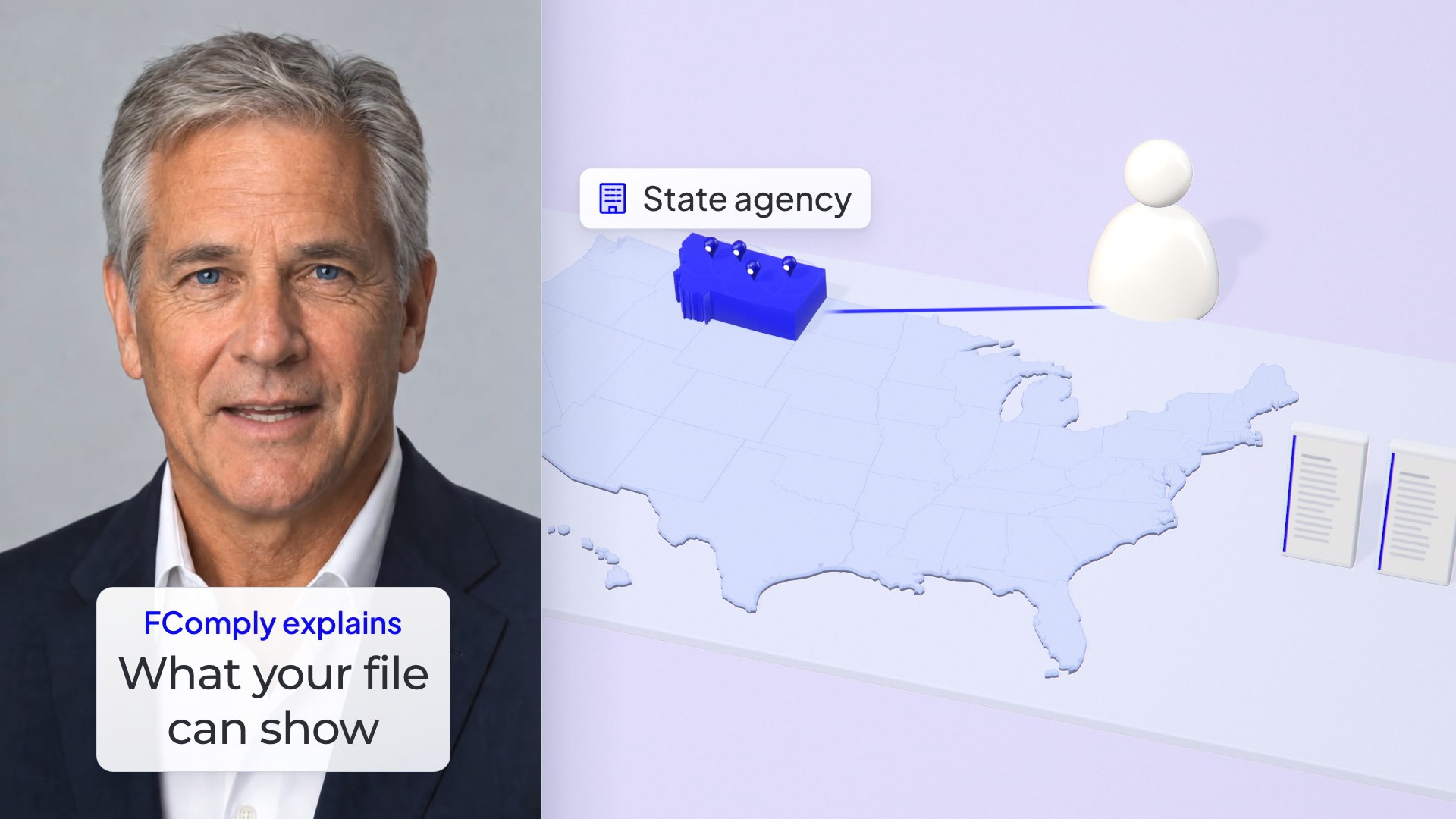
When the auditor asks, here is what the file can show.
Of 100 missing-from-care episodes the federal auditors sampled, 45 were never reported to NCMEC at all.
When the HHS Office of Inspector General audited missing-from-care reporting for 2018 to 2020, it estimated that nearly half of the episodes had never been reported to NCMEC, that a further fifth were reported late, and that nearly one in five were not properly reported to law enforcement for NCIC entry. Those are not failures of intent. They are failures of information: a child is not reported because nobody yet knows the child is gone, and a visit is recorded because a form was completed, not because presence was verified.
47
of missing-from-care episodes never reported to NCMEC (estimate)
22
reported to NCMEC late (estimate)
13,983
episodes not properly reported for NCIC entry (19%, estimate)
HHS-OIG estimates from samples of 100: 74,353 episodes of a child missing two calendar days or more, 46 states, July 2018 to December 2020 (A-07-21-06102 and A-07-21-06104).
State audits and legislative investigations that followed — Georgia’s among the most public — asked the same question of the case file: how do you know?
Five duties, five provable events
Each requires the agency to show, after the fact and to a federal reviewer, that a dated event occurred for a specific child. Every one is a timestamp problem.
Duty · the provable event · the clock
- Missing-child reportinga report to law enforcement for NCIC entry and to NCMEC · immediately, 24 hours at most
- Ongoing coordinationcontinued communication with both · through the child’s recovery
- Monthly visitsa caseworker present with the child · at least 95% of required monthly visits
- Checks before placementa fingerprint check of each prospective foster or adoptive parent and a registry check of every adult in the home
- Title IV-E eligibilitya licensed placement and an eligible period for every claimed dollar
The auditors’ own words for what is missing: agencies “generally lacked adequate systems to readily identify” whether they had reported missing children to NCMEC and law enforcement accurately and on time. Requirement by requirement: The foster care compliance gap.
Three changes, and the first one is the trigger the 24-hour rule depends on.
Three changes
As designed, the Foster Care Compliance System enrolls each child with a real-time photo, then confirms physical presence at the caregiver’s home with a biometric photo capture and precise GPS. A child who cannot be produced for a check is an exception the agency sees the same day, the trigger the 24-hour rule depends on.
Required caseworker visits would be logged, timestamped and geo-verified at the point of contact. Supervisors would see completion in real time, and auditors a record created at the visit, not afterward.
Complied ID, now in development, will verify a caregiver’s identity with document and liveness checks before the background check runs, then rescreen every year, with an alert the same day a rescreen finds a disqualifying record, closing the gap between a one-time approval and a decade of placements.
The desk it lands on


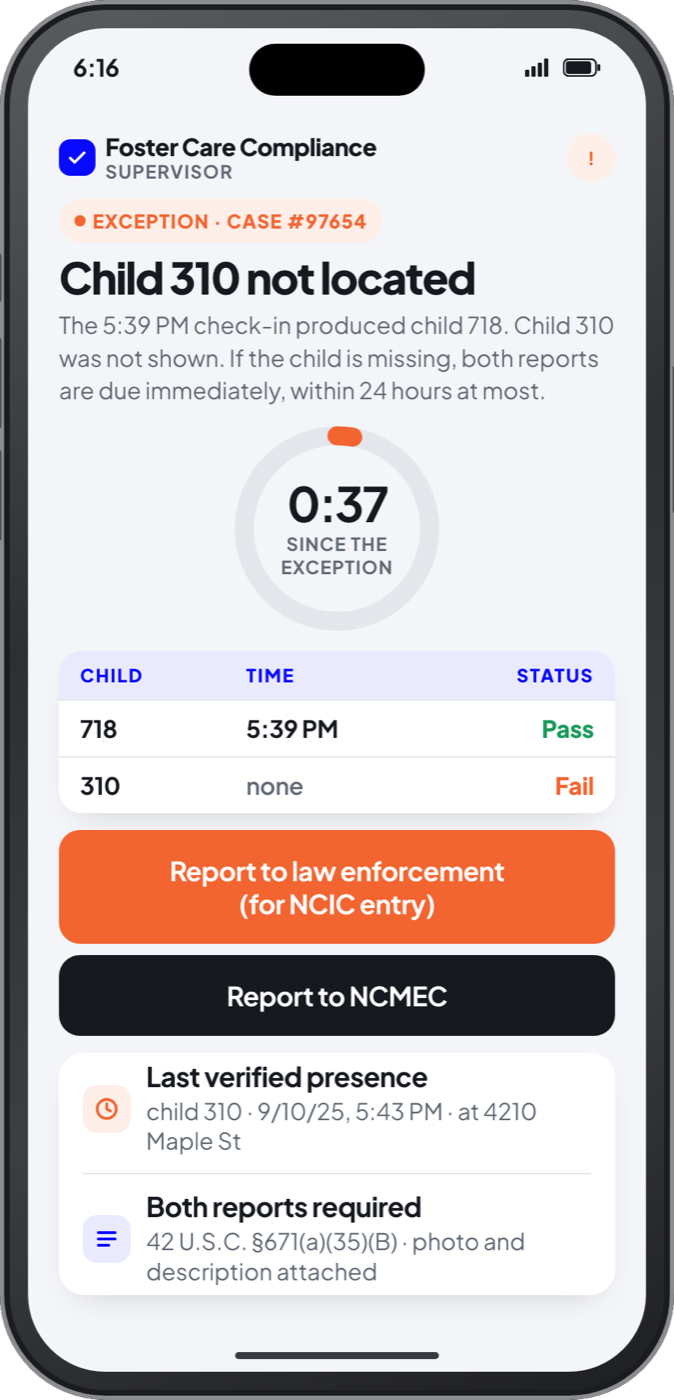
A real-time alert, on the caseworker’s own screenThe statute names the events. This is what one of them looks like the moment it clears — case, time, status, in the record the auditor will read.
An illustrative screen of the Foster Care Compliance System as designed. The system is an active concept that FComply is building with developers and investors.
1
Raised by the caregiver’s failed check-in, not by the next scheduled contact.
2
The 24-hour clock is visible to everyone who can act on it.
3
Both reports the statute requires, one tap each, with the photo and description attached.
Foster Care Compliance System as designed, supervisor view: a child not located at check-in. An illustrative screen.
A missed check-in reaches the supervisor the same day
Both reports, from one clock
Four things, none of which has to be reconstructed afterward — the walkthrough lists them from 0:40.
The four things the file can produce for a reviewer are in the walkthrough from 0:40. Two of them, as the reviewer sees them:
What you can show the reviewer


Visit compliance, by caseworker, month and countyCounted from records made at the door, not from a form filled in afterward. The visits still unverified are named here, not at the audit.

The evidence behind one lineThe photograph that was accepted, the date, the time, and the position it was taken from. One line in the report opens into the thing that produced it.
Illustrative screens of the Foster Care Compliance System as designed.
Read next: state-by-state reporting requirements and audit exposure, or what “digital chain of custody” means in practice.
The documents behind the figures on this page are listed in Supporting material.
Frequently asked questions
Does FComply replace our SACWIS or CCWIS case-management system?
No. As designed, the Foster Care Compliance System sits alongside the case-management system you already run. It would verify identity and physical presence at the moment of each check and produce a timestamped, geo-verified record that your existing systems and auditors can rely on. The system is an active concept that FComply is building with developers and investors.
How does this help with the 24-hour missing-from-care rule?
The rule only works if the agency learns a child is missing quickly. As designed, geo-verified check-ins and monthly visit verification would flag a child who cannot be produced for a check the same day, so the agency can follow up and, if the child is missing, report immediately rather than after the next scheduled contact.
What does the state receive when the OIG or a legislative auditor asks for proof?
As the system is designed, a longitudinal record for each child: enrollment photo, every verified check-in with time and location, every completed caseworker visit, and every exception. It is the evidence an audit asks for, produced as a by-product of daily practice rather than reconstructed afterward.
Is personal data about children stored by FComply?
The agency owns the child’s record. FComply is designed to hold as little as possible: the enrollment photo is used only to confirm the same child at each check-in, and location is captured only at the check-in. The specifics for your state would be set out in the contract.
Protect the vulnerable and build trust at scale.
© 2026 Federal Compliance Systems, Inc. All rights reserved.