
Federal law sets two standards for every child in foster care. The first is a caseworker visit every month. The second is a report immediately, and in no case later than 24 hours, when a child goes missing. Both belong to the state, but in practice they land first on the agency closest to the child, and they rest on what your caseworkers know and when they know it.
For foster care and child-placing agencies
You supervise the placements, complete the monthly visits and answer first when a child cannot be found. FComply is building a system to make each of those verifiable, in the moment.
Listen to this page 2 min
Loading the Elevenlabs Text to Speech AudioNative Player...
Designed to verify each monthly visit at the door
Designed as one record for you and the state
Walk me through it · about two and a half minutes
Can a state meet the visit standard and still miss a child for months?

Four gaps, and none of them looks like a failure on the day it happens.
- A monthly visit written up afterward, from memory or a paper form, with nothing to show where or when it happened.
- A child missing from care, and the reports to law enforcement and NCMEC made late or not at all.
- A placement payment that continues after the child has gone missing.
- A foster parent or staff member checked once, years ago, and never again, or a staff member checked by name alone, which can miss a record when someone gives a false identity.
Federal audits found missing-child reports that went out late or never. In a 2022 federal snapshot, 40 state agencies reported that their procedures kept maintenance payments going to the provider after a child went missing, generally to hold the placement, and most stopped within 3 to 30 days.
23,348 missing-from-care reports to NCMEC in 2025
The agency closest to the child often knows first
What can a state’s reported visit rate hide?
A state can meet the 95% standard in aggregate while some children in some offices go without a visit for months. A statewide total cannot show which children those are. A record made for each child, each month, could.
Reported compliance against the federal standard
Monthly visits completedrange across states, FY2013, against the 90% standard then (95% since FY2015)
standard 90%59%99%
Visits in the child’s residencerange across states, FY2013, against a 50% standard that ended October 1, 2025
standard 50%54%100%
Sources: HHS caseworker visit data for FY2013 (CRS R41860, Table G-1); 31 states met the 95% standard in FY2022 (CRS R48503, April 2025); 331,747 children were in care on September 30, 2025 (AFCARS, preliminary). Detail: The foster care compliance gap.
A visit written up from memory is not a verified visit
Many were missing for days, some for weeks (HHS OIG, 2022)
What a visit proves, what a claim rests on, and how often a caregiver is checked.
Three changes
As designed, the Foster Care Compliance System starts with one photograph of each child, taken by the caseworker at enrollment. At each check-in and each monthly visit, a photo taken in the home is added to the child’s record with a GPS position and the time, so supervision would rest on a record made at the visit rather than on paperwork completed afterward.
As designed, each monthly placement claim could point to the visits and check-ins on the child’s record, and a claim with no record behind it would be flagged for the agency to review. Whether a payment continues, for example to hold a placement, stays the agency’s and the state’s decision.
Complied ID is being built. At launch it will prove a caregiver’s identity first, with document checks and a liveness check designed to catch photos, masks and replayed video. Then the background checks will run through the channel the state authorizes, and Complied ID will rescreen every year, with the person’s written consent. A rescreen that finds a disqualifying record will raise an alert the same day.
Designed to show who was seen, where and when
Designed so each claim points to its record
A photo at each visit and check-in, a record made on the spot, and an exception the same day.
The walkthrough shows a monthly visit from 0:39 and the foster parent’s evening check-in from 1:14. The screens below are illustrations of the design.
An evening check-in and a monthly visit

The request arrivesThe foster parent is asked to show both children by 9:00 PM.

The check-inA photo, the place and the time, added to the record.

The monthly visitLogged at the door, not written up that evening.
Illustrations of the design. The Foster Care Compliance System is an active concept that FComply is building with developers and major investors.
A short check-in, at the kitchen counter
Designed so the agency knows the same day
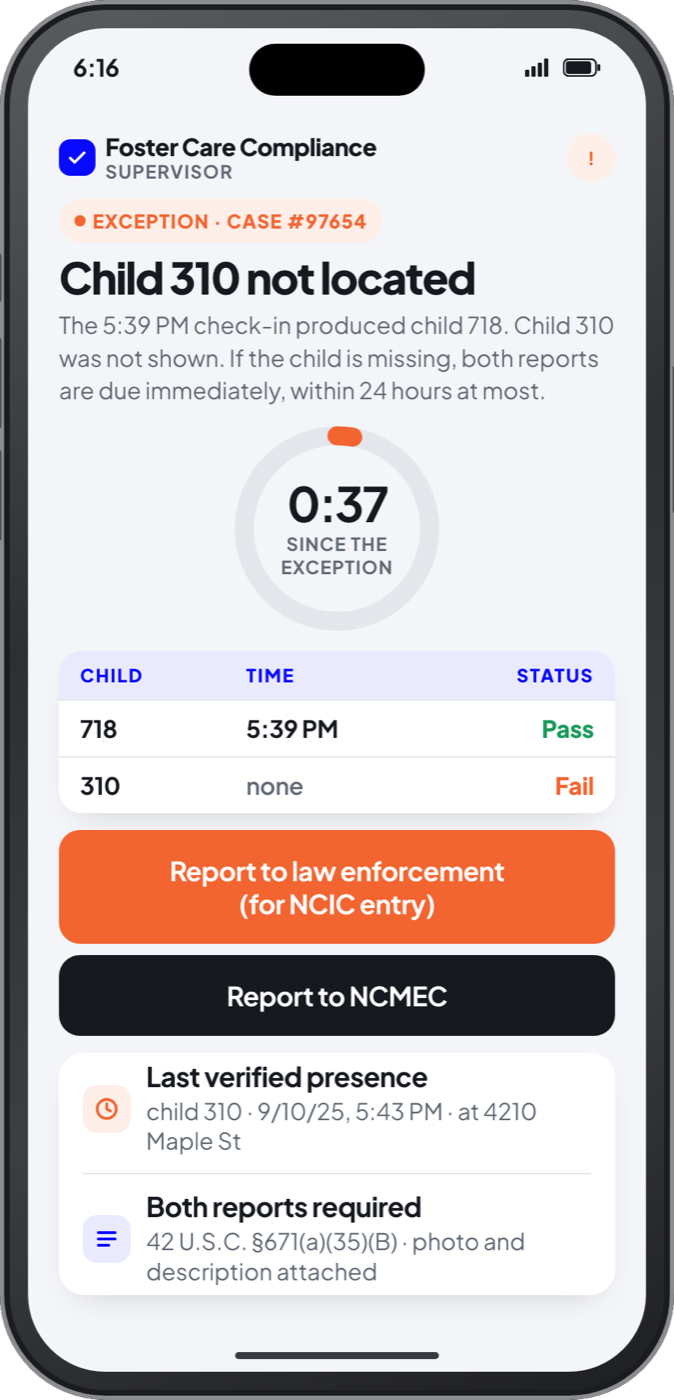
1
The check-in showed one child, not both, so the exception comes from the check-in itself, not from the next visit.
2
The last verified presence is on the record, with which child, when and where.
3
The agency is told the same day and checks whether the child is missing. If so, the report is due immediately, and in no case later than 24 hours, to law enforcement for entry into NCIC and to NCMEC.
The supervisor’s view, as designed, when the evening check-in shows one child and not the other. An illustrative screen.
Read next: what “digital chain of custody” means, or why one-time background checks fail.
The documents behind the figures on this page are listed in Supporting material.
Frequently asked questions
We already record visits in our case-management system. What is different?
Recording that a visit happened is not the same as verifying it. As designed, a photo taken at the visit is added to the child’s record with a GPS position and the time, so the record would show the caseworker was with that child, at that home, at that time. Your case-management system keeps the narrative, and FComply would supply the proof.
Does this work for the state agency’s reporting as well as ours?
It is designed to. The same record would serve your own supervision, your contract with the state and the state’s duties under federal law. A child who cannot be shown at a check-in would be raised once, the same day, rather than found at a later reconciliation, and the duty to report stays with the agency and the state.
How are foster parents and staff screened?
Complied ID is being built. At launch it will prove the person’s identity first, with document and liveness checks. The background checks will then run through the channel each state authorizes, with fingerprints at the site the state names. Federal law requires a fingerprint check for prospective foster parents before final approval, and a child abuse and neglect registry check for them and for the other adults in the home. Complied ID will rescreen every year, with the person’s written consent, and a rescreen that finds a disqualifying record will raise an alert the same day. The proven identity will be shareable with the placing agency and the state, and each decides which checks it accepts. See how it works in your state.
What happens to a placement if a check-in is missed?
As designed, a missed or failed check-in is an exception, not a silent gap. Supervisors would see it the same day and decide what to do, and the record would show what was known and when.
Protect the vulnerable and build trust at scale.
© 2026 Federal Compliance Systems, Inc. All rights reserved.