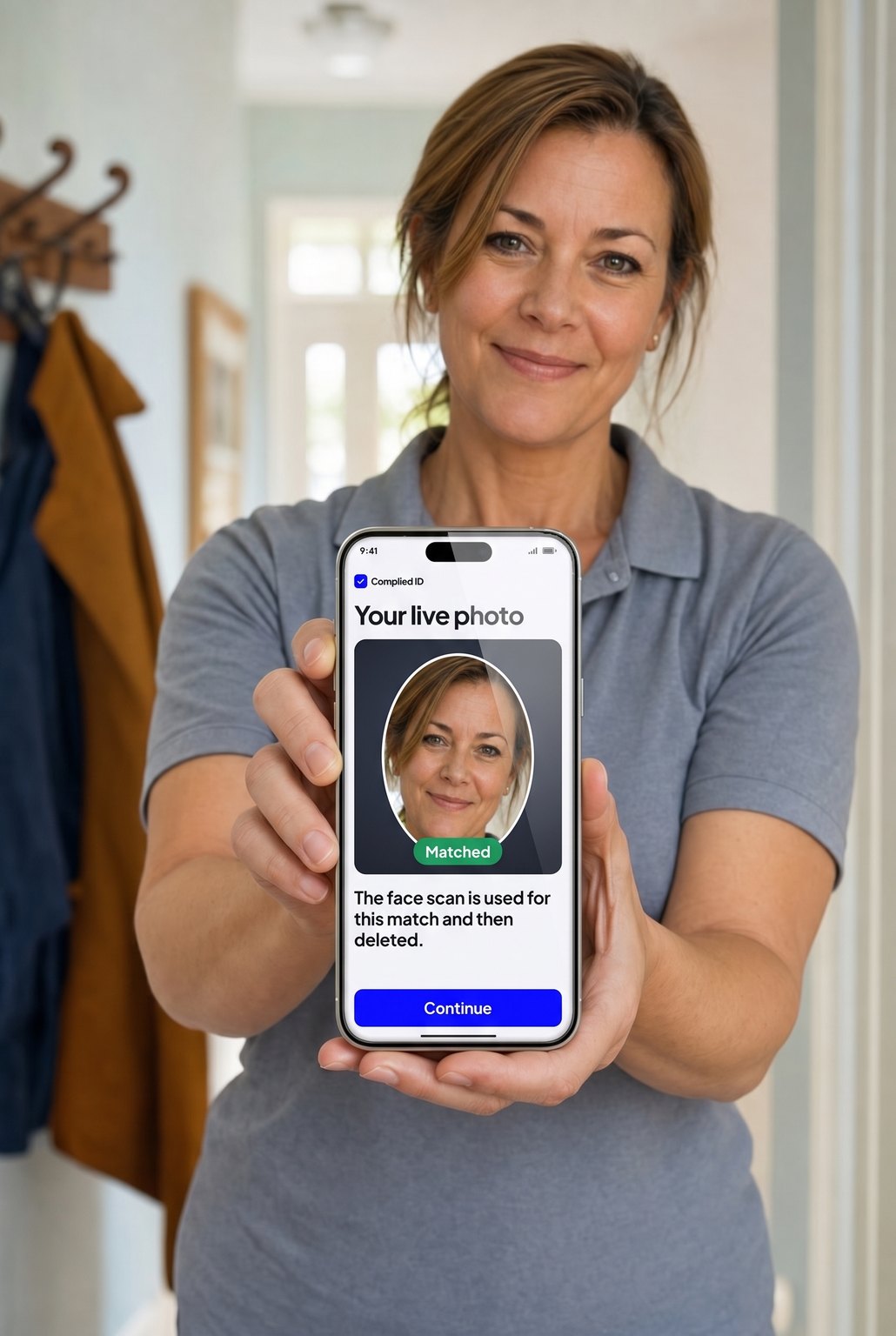
Illustrations of planned screens, with fictional people. Complied ID is being built and will work at launch; the Foster Care Compliance System is an active concept that the company is building with developers and major investors. Research as of October 1, 2026, not legal advice.
How the apps work, state by state
Each app has one design, in every state. What changes is which steps appear and who does each one. Pick a job and a state to see it.
One design, every state
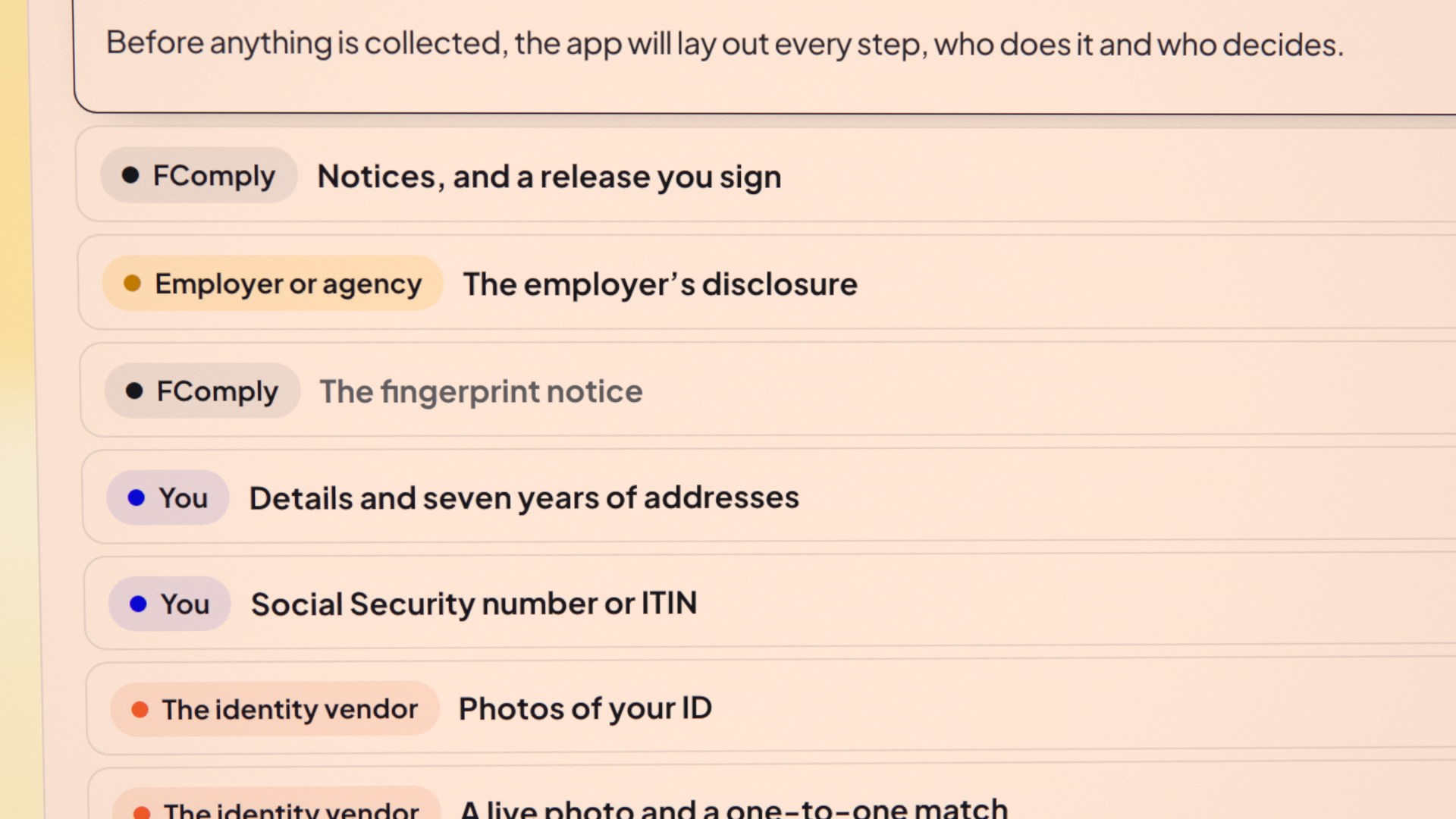
Each step names who does it
Walk me through it · under three minutes
One design, and fifty-one sets of rules.
The interactive explorer needs JavaScript. The sections below summarize its rules in text.
Some steps belong to the state, a partner or the employer. Each card says why.
Nine steps FComply hands to someone else
- Take fingerprints the FBI acceptsA phone cannot take them, so the state names the site. For child care, IdentoGO takes prints in 20 states and Fieldprint in 5, Accurate Biometrics in Illinois and Live Scan operators in California, and state, police or listed sites in the other 24. FComply has no agreement with any of them.
- Get FBI records on its ownFComply has no authority of its own to obtain FBI records. The state agency submits the prints, or the employer through the state’s program, where a law authorizes the check for that job.
- Decide who is eligibleThe law names the decider. It is a state agency for some jobs and states, the employer for others, and for a foster home the agency that licenses it. The result will say who decided.
- Search another state’s registryOnly that state can. The app will prepare one request for each state you lived in, on that state’s own form, and track the answer.
- Notarize a formFComply never notarizes. Many registries need no notary at all; where one is needed, a notary does it, and remotely only where that registry accepts it.
- Match faces itselfAn identity vendor will run the one-to-one match and the liveness check, after you sign the release. The face scan is used for this match and then deleted.
- Show a status before an offer, unless the law puts the check firstSeveral state and city laws allow criminal history only after an offer, so the employer will record a conditional offer first, in every state, unless a law puts the check first, as it does for home care in Connecticut, Louisiana and Arkansas.
- File a report when a child cannot be locatedAgency staff make the report to law enforcement (for NCIC entry) and the report to NCMEC, immediately, and in no case later than 24 hours. FComply never files a report, and the system is designed to record who reported, when, and under which number.
- Count a caregiver check-in as a visitA check-in is never a caseworker visit. The monthly visit, in person, is its own record.
Each handoff is designed to appear in the app as its own step, with the name of whoever takes it over.
Fifteen rules, mapped across the 50 states and the District of Columbia.
Federal law sets a floor for who must be checked, and each state builds on it. States differ on who decides, whether fingerprints are taken and by whom, which registries are searched, what a person agrees to before a camera opens, and when an employer may see a result. The apps are designed to follow those rules step by step, with every step saying who is doing it.
The map needs JavaScript. The sections on this page summarize its rules in text.
“Not yet confirmed” means the research could not settle that point at a state’s own source, so the app is designed to hand the step to FComply staff instead of guessing.
None of these partnerships exists today. Each is an option in the design.
The options, and where each one fits
- Each state’s fingerprint siteThe app will hand off to the site the state names, with the state’s code. A fingerprinting partner of FComply’s own fits only where the state already lets private fingerprinting businesses in: 5 states publish that (Arkansas, Arizona for paper cards, Maryland, Nevada, Utah), and each still needs the state’s approval.
- The state’s own background check programWhere a state agency runs the check and decides, the app will guide the person through the state’s steps and track them, and the employer confirms the result with the state.
- Checks the person can startIn Hawaii, Idaho and Utah, the worker can start the state’s check, and so can nursing care workers in Colorado and aides in the District of Columbia and California. The app will guide them to the state’s own site and submit nothing itself.
- FComply as the employer’s screening vendorSome states let a private company do all or part of a care worker’s check, in most of them behind a license, an approval or an accreditation. FComply holds none of these today.
- An identity verification vendorFComply’s processor for the document check, the live photo and the one-to-one match, after the signed release. In Portland, Oregon, a one-to-one match only.
- Remote online notariesOnly where a registry says it accepts a remote notarization, Idaho and Maryland so far; an in-person notary everywhere else.
- Wallet IDs, laterA mobile ID in Apple Wallet or Google Wallet as another way to prove who you are, in the states on Apple’s and Google’s lists.
- An FBI-approved channeler, laterThe FBI approves the companies that forward fingerprints for checks outside criminal justice, and FComply is not one of them. Working with one is a later option; it never replaces a state program the law requires.
- The foster care partnersLaw enforcement and NCMEC receive the agency’s reports, the state’s licensing agency approves homes, the state’s case system stays the system of record, and fingerprint sites take prints for the foster parents, and in most states for the other adults in the home.
Every option that involves a license, an agreement or a state approval waits on counsel and on the company’s decision.
Each state’s own code, rules and agency pages, read and dated at the source.
The rules on this page come from FComply’s own research for these apps: three rounds across the 50 states and the District of Columbia, finished October 1, 2026. Each value was read at the state’s official code, its administrative rules or the agency’s own pages, and the sentence, the address and the date it was read are kept with it. A second AI model reviewed each round, and every point it raised was checked again at the source.
Where a source could not settle a point, the page says “Not yet confirmed” and the app is designed to hand that step to FComply staff. Laws change, so each value carries its date.
Research, not legal advice. Counsel has not reviewed it. Vendors are named only where the state’s own pages name them, and FComply has no agreement with any of them.
Frequently asked questions
Does each state get its own version of the app?
No. Each app has one design and the same stages everywhere. In the design, a small rule file for each state and job decides which steps appear, who does each one and what the screen says. A version for each state would mean 51 apps to review, test and keep in step.
Does FComply take fingerprints?
No. A phone cannot take fingerprints the FBI accepts, and FComply has no authority of its own to obtain FBI records. Where a state requires prints, the app will hand you to the site that state names, with the state’s code, and track the result. FComply has no agreement with any fingerprint company.
Who decides whether someone may work or foster?
The law names the decider: a state agency for many jobs, the employer for others, and for a foster home the agency that licenses it. FComply will run the process and show the result with its date. It won’t decide who’s eligible.
When will the apps work like this?
Complied ID is being built and will work at launch. The Foster Care Compliance System is an active concept that the company is building with developers and major investors, and what it does here is what it is designed to do. Some design choices are still open, and the page will change with them.
Protect the vulnerable and build trust at scale.
© 2026 Federal Compliance Systems, Inc. All rights reserved.